


CUSTOMER SUCCESS STORY | CONSUMER GOODS AND RETAIL
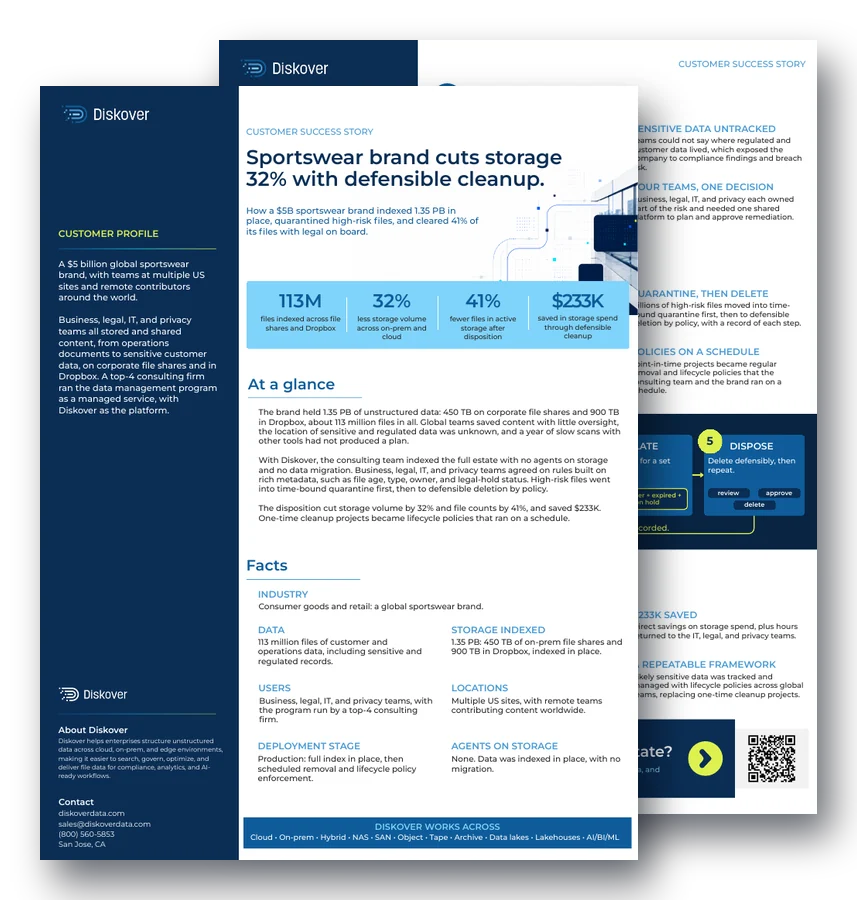
Sportswear brand cuts storage 32% with defensible cleanup.
How a $5B sportswear brand indexed 1.35 PB in place, quarantined high-risk files, and cleared 41% of its files with legal on board.
113M
files indexed across file shares and Dropbox
32%
less storage volume across on-prem and cloud
41%
fewer files in active storage after disposition
$233K
saved in storage spend through defensible cleanup
At a glance.
The brand held 1.35 PB of unstructured data: 450 TB on corporate file shares and 900 TB in Dropbox, about 113 million files in all. Global teams saved content with little oversight, the location of sensitive and regulated data was unknown, and a year of slow scans with other tools had not produced a plan.
With Diskover, the consulting team indexed the full estate with no agents on storage and no data migration. Business, legal, IT, and privacy teams agreed on rules built on rich metadata, such as file age, type, owner, and legal-hold status. High-risk files went into time-bound quarantine first, then to defensible deletion by policy.
The disposition cut storage volume by 32% and file counts by 41%, and saved $233K. One-time cleanup projects became lifecycle policies that ran on a schedule.
Customer profile
A $5 billion global sportswear brand, with teams at multiple US sites and remote contributors around the world.
Business, legal, IT, and privacy teams all stored and shared content, from operations documents to sensitive customer data, on corporate file shares and in Dropbox.
A top-4 consulting firm ran the data management program as a managed service, with Diskover as the platform.
Data
113 million files of customer and operations data, including sensitive and regulated records.
Storage indexed
1.35 PB: 450 TB of on-prem file shares and 900 TB in Dropbox, indexed in place.
Users
Business, legal, IT, and privacy teams, with the program run by a top-4 consulting firm.
Locations
Multiple US sites, with remote teams contributing content worldwide.
Challenges.
Unmanaged growth.
Global teams saved content to shared storage with little oversight, and volumes grew past what any team could review folder by folder.
Sensitive data untracked.
Teams could not say where regulated and customer data lived, which exposed the company to compliance findings and breach risk.
Scans that took weeks.
Previous tools needed weeks for each pass, and after a year the data was growing faster than the team could assess it.
Four teams, one decision.
Business, legal, IT, and privacy each owned part of the risk and needed one shared platform to plan and approve remediation.
Solutions.
Full index, in place.
Diskover indexed 450 TB of file shares and 900 TB of Dropbox, with no agents installed on storage and the data staying where it was.
Quarantine, then delete.
Millions of high-risk files moved into time-bound quarantine first, then to defensible deletion by policy, with a record of each step.
Metadata rules for action.
Teams built searches on rich metadata, such as file age, type, size, and owner, to find files left by former employees (orphaned data) and files under legal hold.
Policies on a schedule.
Point-in-time projects became regular removal and lifecycle policies that the consulting team and the brand ran on a schedule. See file data retention.
“Sensitive data is a location problem before it is a policy problem. Once legal, privacy, and IT saw the same inventory, they could agree on what to keep, what to quarantine, and what to delete.”
Bill Burns, Director of Digital Archaeology, Diskover
How it works.
1. Index
Shares and Dropbox indexed in place.
2. Rules
Agreed by business, legal, IT, and privacy: age, owner, type, legal hold.
3. Review
Across shares and cloud: what is likely sensitive, what is expired, what former employees left behind.
4. Isolate
Quarantine for a set time: former owner, expired, not on hold.
5. Dispose
Delete defensibly, then repeat.
Files stay in place until a policy acts on them. Every action is recorded.
Outcomes.
32% less storage.
Total storage volume across file shares and Dropbox dropped by nearly a third through defensible cleanup at scale.
$233K saved.
Direct savings on storage spend, plus hours returned to the IT, legal, and privacy teams.
41% fewer files.
Tens of millions of redundant, expired, and high-risk files left active storage.
A repeatable framework.
Likely sensitive data was tracked and managed with lifecycle policies across global teams, replacing one-time cleanup projects.
Questions people ask.
What is defensible deletion?
Removing data according to rules that the business, legal, IT, and privacy teams agreed on, with a record of each step. Here, high-risk files went into time-bound quarantine first, then were deleted by policy.
How do you find sensitive data across file shares and Dropbox?
Index everything in place and search on rich metadata, such as file age, type, owner, and legal-hold status. Diskover works from metadata and never reads file contents. Explore sensitive data discovery.
How did legal, IT, and privacy agree on what to delete?
They worked from the same inventory. Once all four teams saw where content lived, they agreed on rules for what to keep, what to quarantine, and what to delete.
Did Diskover need agents or a data migration?
No. Diskover indexed 450 TB of file shares and 900 TB of Dropbox with no agents installed on storage and no data migration.
What results did the sportswear brand get?
32% less storage volume, 41% fewer files in active storage, and $233K saved in storage spend, with one-time cleanup projects replaced by lifecycle policies on a schedule.
Related resources.
See it on your own data.
We’ll index a sample of your environment and show you
what’s recoverable against your current storage spend.