


UNSTRUCTURED DATA MANAGEMENT
One catalog to see, move, and act on every file you own.
Diskover is the unstructured data management solution that indexes every file across every storage vendor, tier, and location. The data stays in place while the catalog is built, so you can recover capacity, enforce retention, and deliver AI-ready data from one view.
Can you see every file you own?
30–50%
of storage reclaimed by tiering and removing ROT data
30+
hours a week returned to teams from manual data housekeeping
1.4B
files indexed in 2 hours on 3 nodes
I NEED TO
WHAT IT IS AND WHY IT MATTERS
What unstructured data management covers.
Unstructured data management is the practice of finding, organizing, moving, and governing file and object data across every system that stores it. That covers documents, images, video, research output, design files, and logs on network-attached storage, object storage, cloud, and archive tiers.
Gartner puts unstructured data at 70% to 90% of organizational data (Gartner, 2026). It is spread across systems that each report on their own slice, so teams pay to store files they cannot find, classify, or safely remove. A complete solution gives you one view of all of it, and the means to act on what you see.
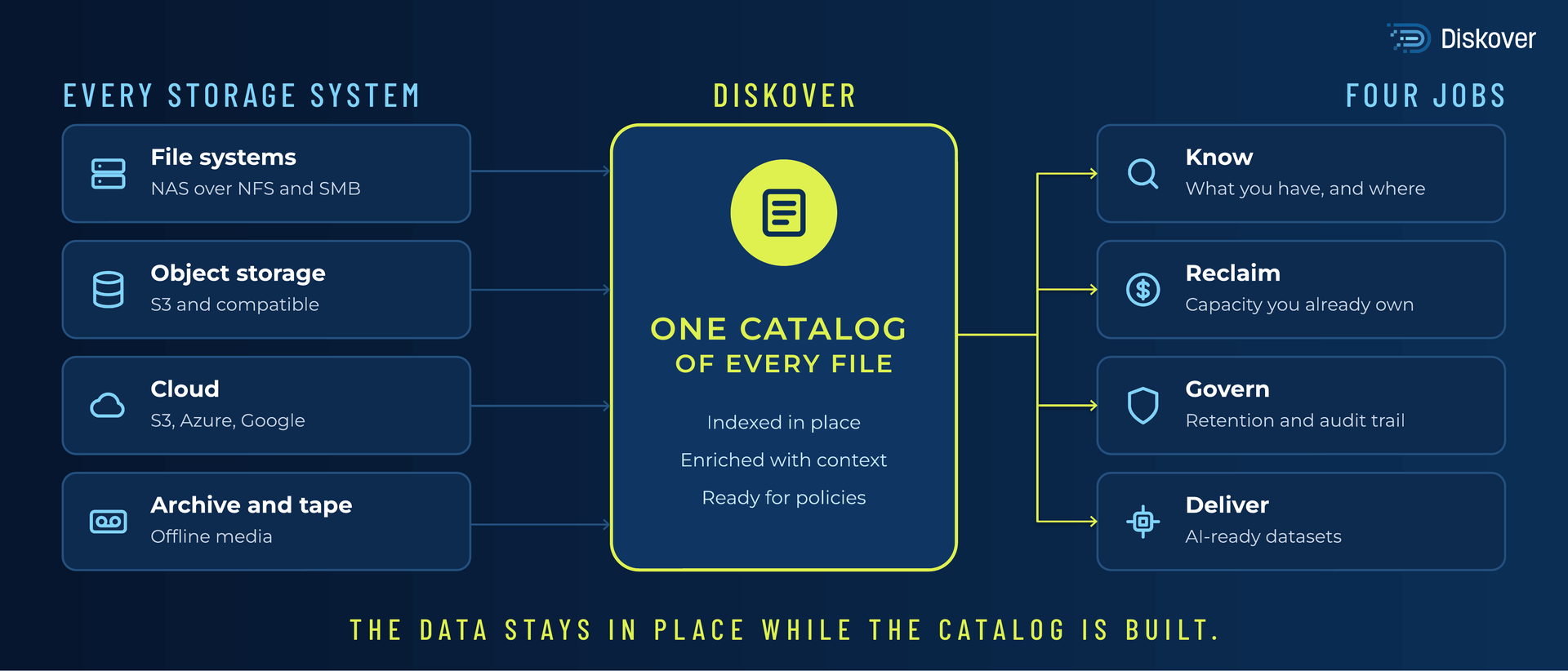
WHAT DISKOVER DOES
Four jobs, one catalog.
Ask your storage a question.
Ask which files have not been touched in 12 months, or what archiving them would save, and get the matching files back with a recommended action. Every action waits for a person to approve it.
AI-ASSISTED. HUMAN-APPROVED.
HOW IT WORKS
Index in place. Enrich. Act.
INDEX IN PLACE
ENRICH
ACT
A global media and entertainment company indexed 260 PB, reclaimed 8 PB, and saved $10M.
100B+
files cataloged in one place
Diskover Media and Entertainment customer
CHOOSING A SOLUTION
Five questions to ask any unstructured data management solution.
Gartner predicts that through 2028, building your own unstructured metadata solution will cost over 300% more than buying one (Gartner, 2026). If you are evaluating platforms, start with these questions. Here is how Diskover answers each one.
WHERE IT FITS
Built for the storage and industries you already run.
Diskover indexes file and object storage from any vendor, on-premises and in the cloud, for teams in every industry. Explore our key partners and the industries we know best.
FAQ
Common questions.

See what is in your storage.
We will index a sample of your storage and show you what is recoverable against your current storage spend.