


CUSTOMER SUCCESS STORY | SEMICONDUCTOR
Semiconductor leader saves millions with one inventory.
How a global chip design company turned four sites and about 8,000 storage volumes into one inventory, then put cleanup on a schedule.
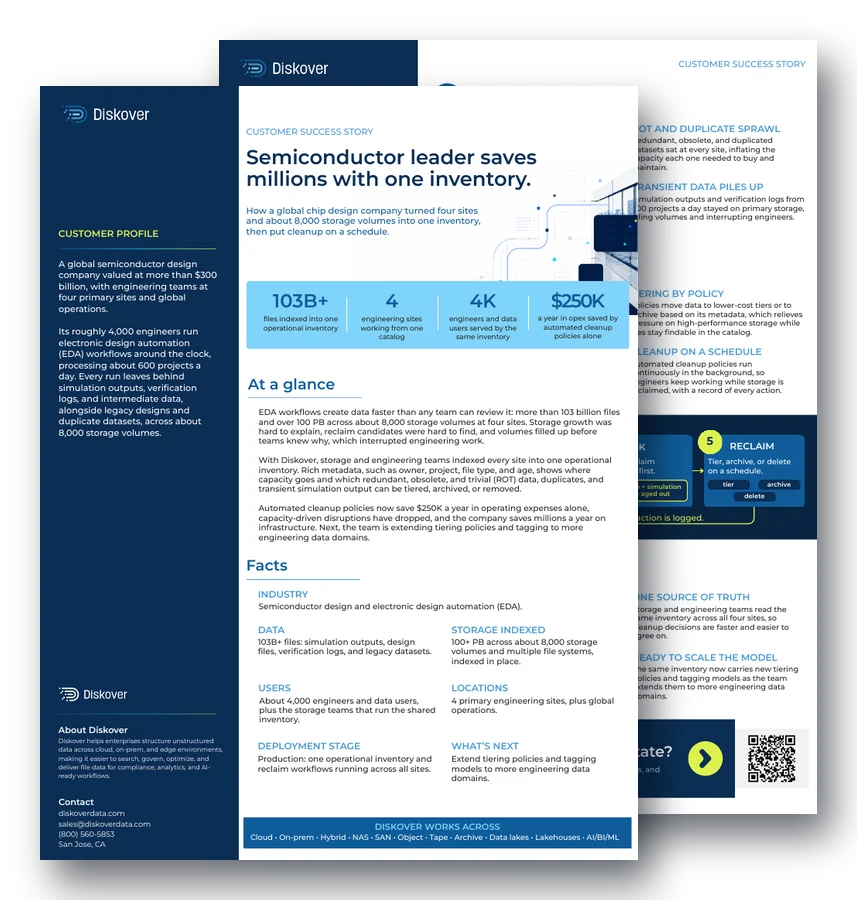
103B+
files indexed into one operational inventory
4
engineering sites working from one catalog
4K
engineers and data users served by the same inventory
$250K
a year in opex saved by automated cleanup policies alone
At a glance.
EDA workflows create data faster than any team can review it: more than 103 billion files and over 100 PB across about 8,000 storage volumes at four sites. Storage growth was hard to explain, reclaim candidates were hard to find, and volumes filled up before teams knew why, which interrupted engineering work.
With Diskover, storage and engineering teams indexed every site into one operational inventory. Rich metadata, such as owner, project, file type, and age, shows where capacity goes and which redundant, obsolete, and trivial (ROT) data, duplicates, and transient simulation output can be tiered, archived, or removed.
Automated cleanup policies now save $250K a year in operating expenses alone, capacity-driven disruptions have dropped, and the company saves millions a year on infrastructure. Next, the team is extending tiering policies and tagging to more engineering data domains.
Customer profile
A global semiconductor design company valued at more than $300 billion, with engineering teams at four primary sites and global operations.
Its roughly 4,000 engineers run electronic design automation (EDA) workflows around the clock, processing about 600 projects a day.
Every run leaves behind simulation outputs, verification logs, and intermediate data, alongside legacy designs and duplicate datasets, across about 8,000 storage volumes.
Data
103B+ files: simulation outputs, design files, verification logs, and legacy datasets.
Storage indexed
100+ PB across about 8,000 storage volumes and multiple file systems, indexed in place.
Users
About 4,000 engineers and data users, plus the storage teams that run the shared inventory.
Locations
4 primary engineering sites, plus global operations.
Challenges.
Growth without a cause.
Consumption climbed across sites, systems, and file types, and teams could not pinpoint which projects or workflows were driving it.
ROT and duplicate sprawl.
Redundant, obsolete, and duplicated datasets sat at every site, inflating the capacity each one needed to buy and maintain.
No way to rank cleanup.
With more than 103 billion files, teams had no consistent method to find the best reclaim candidates or decide where to start.
Transient data piles up.
Simulation outputs and verification logs from 600 projects a day stayed on primary storage, filling volumes and interrupting engineers.
Solutions.
One operational inventory.
Diskover indexes all four sites and about 8,000 storage volumes in place into one catalog, so storage and engineering teams see use and hotspots from a single view.
Tiering by policy.
Policies move data to lower-cost tiers or to archive based on its metadata, which relieves pressure on high-performance storage while files stay findable in the catalog.
Reclaim candidates surfaced.
Searches and reports group ROT, duplicates, and transient hotspots by project, owner, and age, so teams start with the data that frees the most capacity.
Cleanup on a schedule.
Automated cleanup policies run continuously in the background, so engineers keep working while storage is reclaimed, with a record of every action.
“EDA data grows on its own schedule. When every site reports into one inventory, storage teams can see which runs are finished, what is still in use, and what can move, before capacity turns into an outage.”
Brandon Langley, Senior Director of Engineering, Diskover
How it works.
1. Index
4 sites, about 8,000 volumes, in place.
2. Enrich
Each file carries metadata, such as project, owner, file type, and age.
3. Find
Hotspots by site and project: ROT, duplicates, and output from finished EDA runs.
4. Rank
Biggest reclaim candidates first: finished run, simulation output, aged out.
5. Reclaim
Tier, archive, or delete on a schedule.
EDA jobs keep running while cleanup works in the background. Every action is logged.
Outcomes.
Millions saved a year.
Cleanup, tiering, and avoided expansion save millions a year, including $250K a year in opex from automated policies alone.
One source of truth.
Storage and engineering teams read the same inventory across all four sites, so cleanup decisions are faster and easier to agree on.
Fewer capacity disruptions.
Outages from overfull volumes dropped, so engineers spend their time on design work instead of waiting for storage.
Ready to scale the model.
The same inventory now carries new tiering policies and tagging models as the team extends them to more engineering data domains.
Questions people ask.
Why does EDA data grow so fast?
EDA workflows run around the clock. Here, about 4,000 engineers process about 600 projects a day, and every run leaves behind simulation outputs, verification logs, and intermediate data, alongside legacy designs and duplicate datasets.
How do you find the best storage to reclaim among billions of files?
Group the candidates by metadata. Searches and reports group ROT, duplicates, and transient hotspots by project, owner, and age, so teams start with the data that frees the most capacity. Explore storage reclamation.
Can cleanup run without interrupting engineers?
Yes. Automated cleanup policies run continuously in the background while EDA jobs keep running, and every action is logged.
How much did this semiconductor company save?
Millions a year from cleanup, tiering, and avoided expansion, including $250K a year in operating expenses from automated cleanup policies alone.
How many files can Diskover index into one inventory?
At this company, more than 103 billion files and over 100 PB across about 8,000 storage volumes at four sites. Explore metadata indexing.
Related resources.
See it on your own data.
We’ll index a sample of your environment and show you
what’s recoverable against your current storage spend.