

ENRICHED METADATA CATALOG
One catalog, every file, with the who, what, and why attached.
Diskover indexes every file across every storage vendor, tier, and location into one metadata catalog, then adds the context your business runs on: project, owner, status, and lineage. Search, policies, the AI Connector, and AI/BI pipelines all work from the same catalog, while the data stays in place.
WHAT IT IS
What a metadata catalog is.
A metadata catalog is a searchable index of information about your files: what each file is, where it lives, who owns it, and when it was last used. It holds the description of every file, not a copy of it.
Most organizations cannot see that far. Thales reports that only 34% of organizations know where all their data is. Diskover builds one catalog for file and object data across every storage vendor, tier, and location, so every team searches the same place.
34%
of organizations know where all their data is.
Thales, 2026 Data Threat Report
Like a librarian, the catalog knows every file by its card, without reading every page.
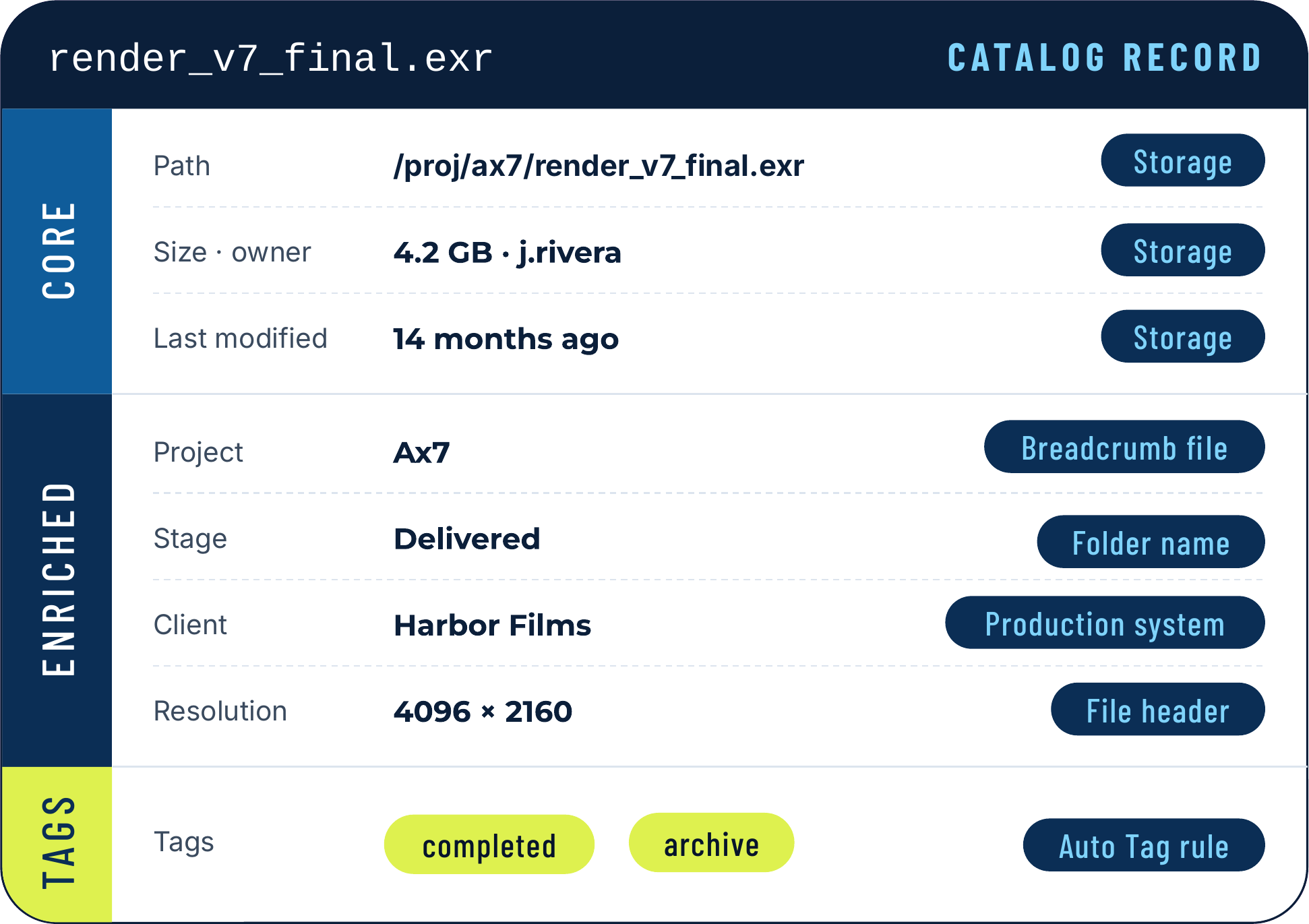
HOW A RECORD GROWS
Three layers of context on every file.
The more Diskover knows about a file, the more precise the search and the action.
FROM STORAGE
Core metadata
FIELDS: name, path, size, type, owner, group, permissions, dates.
BUSINESS CONTEXT
Enriched metadata
FIELDS: project, department, client, workflow stage, cost, media details, genomics info.
DECISIONS
Tags
FIELDS: approved, archive candidate, legal hold, retention class, delete candidate, ai-ready.
WHERE THE CONTEXT COMES FROM
Your workflows already describe your files.
The context your teams need is already there, in names, folders, file headers, and business systems. Diskover harvests it into searchable fields with several metadata enrichment plugins.
File and folder names
Project codes, client names, versions, and dates are already written into names. Path Tokens splits them into searchable words.
ClientABC/ProjectPhoenix_Final_2024-01-15
Becomes →
client • abc • project • phoenix • final • 2024-01-15
Folder structure
Folder names show the workflow stage, and File Kind sorts file types into the categories your teams already use every day.
/incoming → /QC → /delivered
Breadcrumb
A small key-value file in a project folder adds its owner, project, department, and cost center to that folder’s record.
project: AlphaResearch
cost_center: CC-4521
File headers
IImage, media, PDF, OpenEXR, and BAM plugins read the metadata embedded in file headers, so teams can search by camera, codec, or author without opening a single file.
camera settings • codec • resolution • author • sample ID • bam info
Business systems
Data from your asset, order, and production systems joins the file record, including CSV exports, Xytech Media, Autodesk Flow Production Tracking, and Avid.
case ID • order status • shot status
Storage systems
Storage details sit next to the file metadata: Dell PowerScale SmartPools, Dell quotas, Dell Unity, and Windows and Unix ownership and permissions.
tier • quota • owner • open permissions
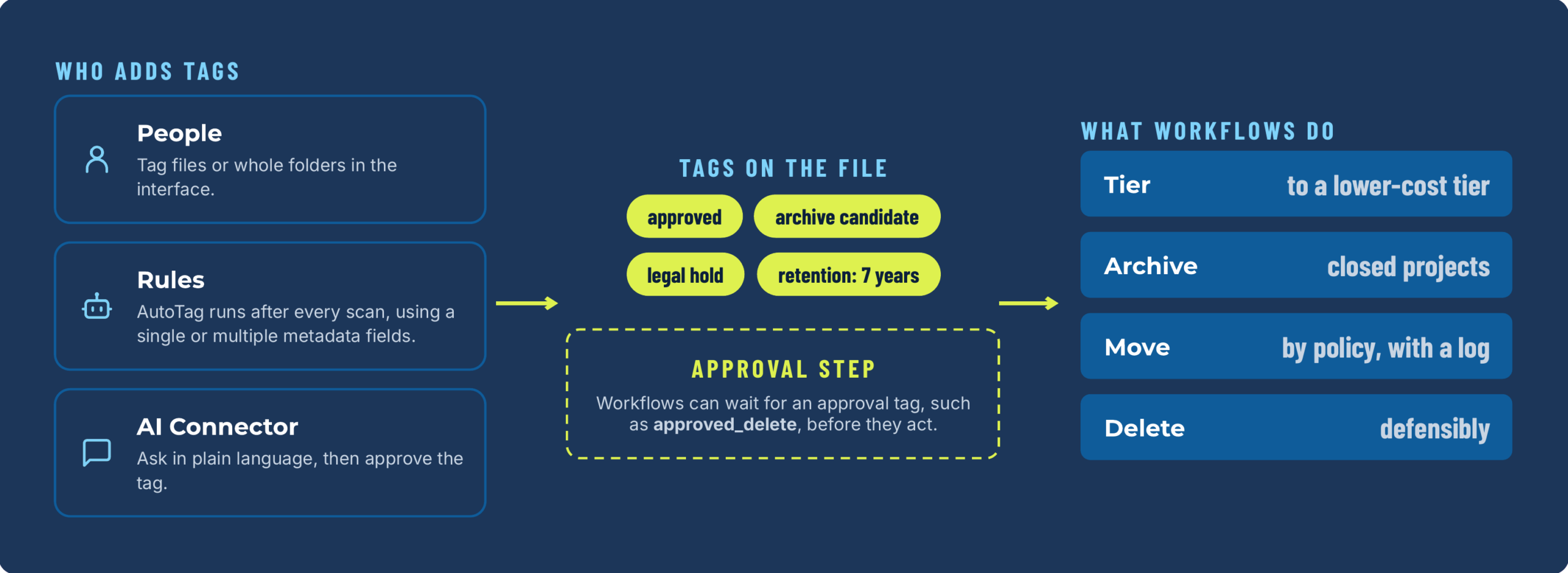
TAGGING
Tags turn context into decisions.
A tag records a decision about a file, so every team and every workflow reads the same answer. Tags come from three places, and they stay with the file.
WHAT IT POWERS
One catalog behind every Diskover capability.
Every capability reads and writes the same catalog, so a tag added in one place is visible everywhere.
1.4B
files indexed in 2 hours, on 3 nodes
29
metadata enrichment plugins
435+
platform features
LINEAGE
Your data’s story matters more than its zip code.
Where a file sits is only the start. Support governance efforts with traceable lineage that helps teams answer audits, retention questions, and policy reviews faster.
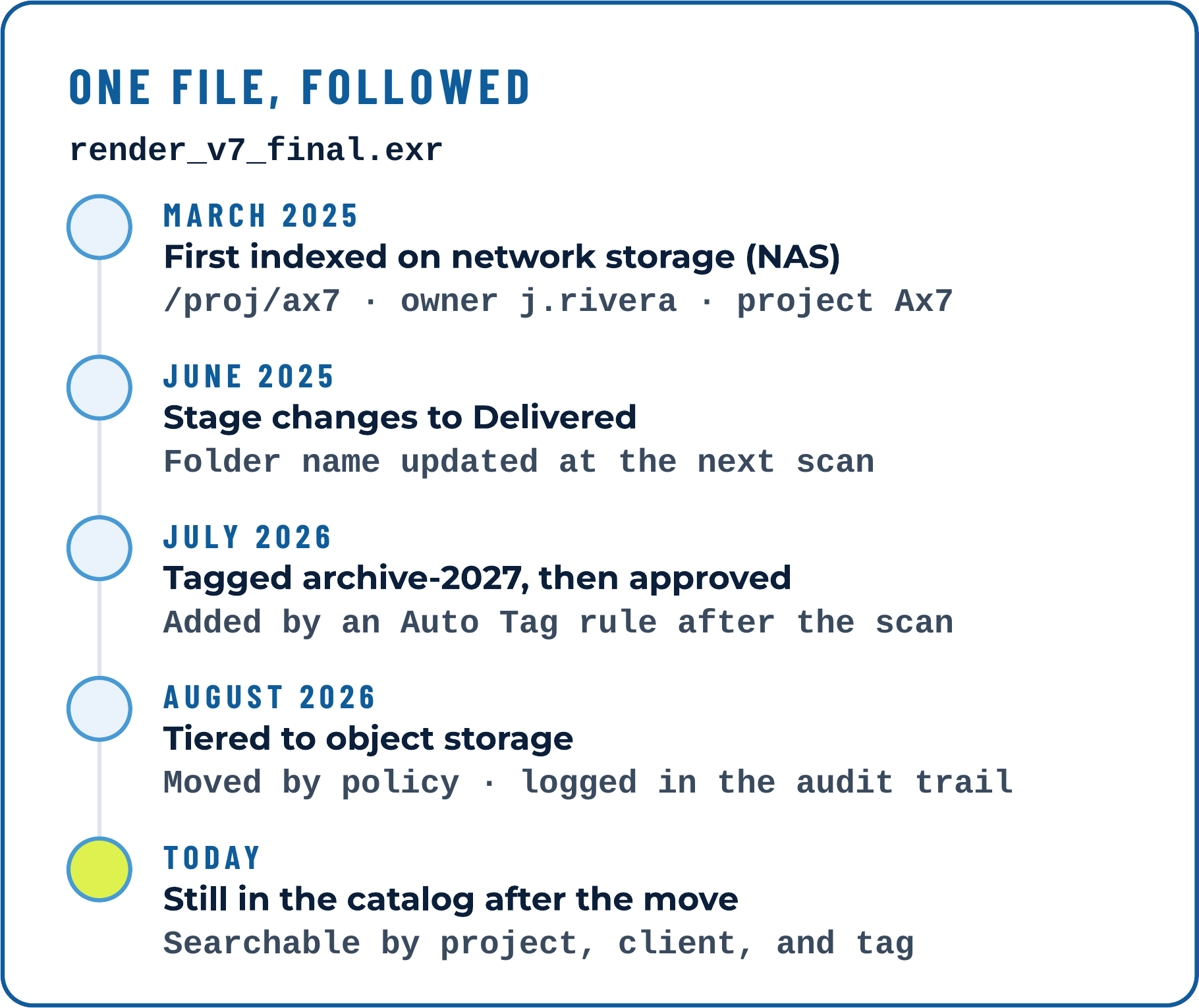
How tagging enriches your catalog.
USE CASE
Media giant searches 300 million files from one place.
A global media company indexed more than 300 million files across 4 storage platforms into one searchable catalog. Eleven users across engineering, media operations, and finance now find files in minutes instead of hours, and Auto Tag rules drive the retention policies that keep storage lean.
300M+
files in one catalog
4
storage platforms in one catalog
Minutes
for lookups that used to take hours
AI AGENTS
Agent-ready data starts with a metadata catalog.
AI agents choose their own files while they work. They read the catalog record before they open a file, so the catalog decides what an agent finds, uses, and leaves out.
FAQ
Questions about the metadata catalog.
See it on your own data.
We’ll index a sample of your environment and show you what’s recoverable against your current storage spend.