


SOLUTION BRIEF | MANUFACTURING, AUTO, AND TRANSPORTATION
From design to warranty, every file accounted for.
One enriched metadata catalog for engineering, plant, and test data across HPC, NAS, object, cloud, and archive.
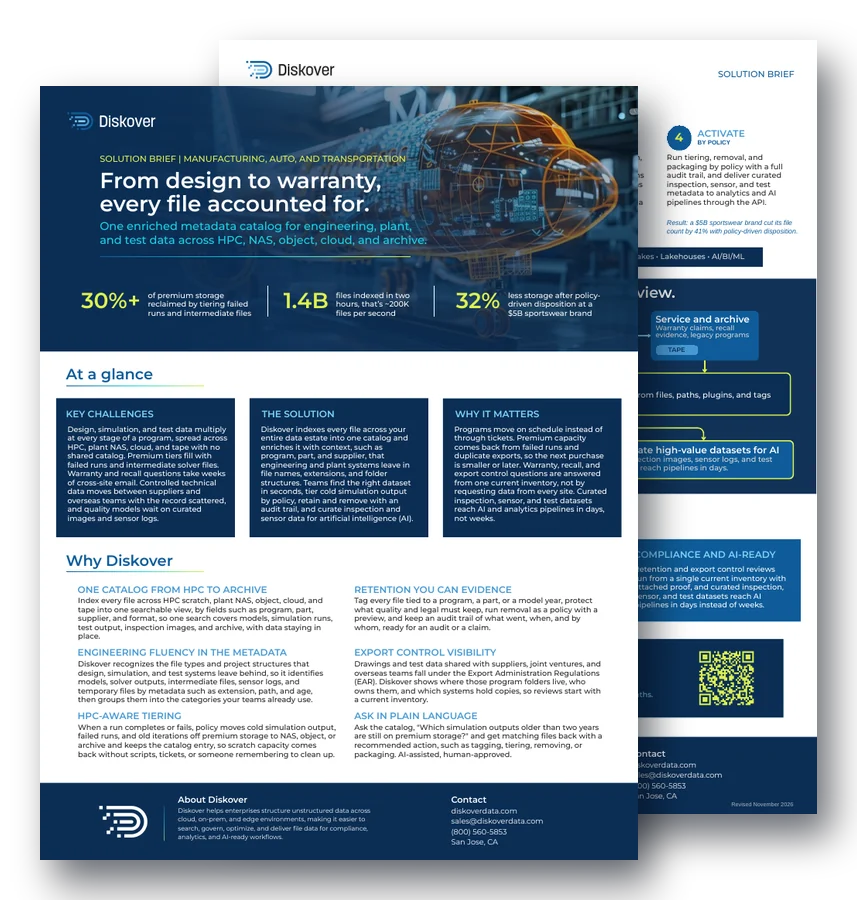
30%+
of premium storage reclaimed by tiering failed runs and intermediate files
1.4B
files indexed in two hours, about 200K files per second
32%
less storage after policy-driven disposition at a $5B sportswear brand
At a glance.
Key challenges.
Design, simulation, and test data multiply at every stage of a program, spread across HPC, plant NAS, cloud, and tape with no shared catalog. Premium tiers fill with failed runs and intermediate solver files. Warranty and recall questions take weeks of cross-site email, and quality models wait on curated images and sensor logs.
The solution.
Diskover indexes every file across your entire data estate into one catalog and enriches it with context, such as program, part, and supplier, that engineering and plant systems leave in file names, extensions, and folder structures. Teams find the right dataset in seconds, tier cold simulation output by policy, retain and remove with an audit trail, and curate inspection and sensor data for AI.
Why it matters.
Programs move on schedule instead of through tickets. Premium capacity comes back from failed runs and duplicate exports, so the next purchase is smaller or later. Warranty, recall, and export control questions are answered from one current inventory, and curated datasets reach AI pipelines in days, not weeks.
Why Diskover.
One catalog from HPC to archive.
Index every file across HPC scratch, plant NAS, object, cloud, and tape into one searchable view, by fields such as program, part, supplier, and format, so one search covers models, simulation runs, test output, inspection images, and archive, with data staying in place.
Retention you can evidence.
Tag every file tied to a program, a part, or a model year, protect what quality and legal must keep, run removal as a policy with a preview, and keep an audit trail of what went, when, and by whom, ready for an audit or a claim.
Engineering fluency in the metadata.
Diskover recognizes the file types and project structures that design, simulation, and test systems leave behind, so it identifies models, solver outputs, intermediate files, sensor logs, and temporary files by metadata such as extension, path, and age.
Export control visibility.
Drawings and test data shared with suppliers, joint ventures, and overseas teams fall under the Export Administration Regulations (EAR). Diskover shows where those program folders live, who owns them, and which systems hold copies, so reviews start with a current inventory.
HPC-aware tiering.
When a run completes or fails, policy moves cold simulation output, failed runs, and old iterations off premium storage to NAS, object, or archive and keeps the catalog entry, so scratch capacity comes back without scripts, tickets, or someone remembering to clean up.
Ask in plain language.
Ask the catalog, “Which simulation outputs older than two years are still on premium storage?” and get matching files back with a recommended action, such as tagging, tiering, removing, or packaging. AI-assisted, human-approved.
How it works.
1. Connect
STORAGE OR IT TEAM
Point Diskover at HPC file systems, plant NAS, object, cloud, and tape libraries. Indexing runs in place, so models and simulation outputs stay where engineering and compute expect them.
Example: a plant NAS is cataloged where it sits.
2. Catalog
AUTOMATION
Every file becomes a searchable record with rich metadata, such as name, path, and owner, enriched with program and part tokens from the path, directory lineage, and classification tags.
Example: a CAD model now shows its program, part, owner, and age.
3. Curate
ANY AUTHORIZED TEAM
Tag by fields such as program, part, plant, and status. Build saved searches for what teams ask weekly, such as failed runs still on scratch, exports past retention, or every file tied to a recalled part.
Example: an engineer or quality lead saves “recalled parts” as a search.
4. Activate
BY POLICY
Run tiering, removal, and packaging by policy with a full audit trail, and deliver curated inspection, sensor, and test metadata to analytics and AI pipelines through the API.
Result: a $5B sportswear brand cut its file count by 41% with policy-driven disposition.
Key outcomes.
Answers in seconds.
Engineers and quality teams find the right model, run, or test file in one search instead of tickets and email, so warranty, recall, and audit questions stop pulling people off program work.
Storage that stays clean.
Storage teams move failed runs, intermediate solver files, and duplicate exports off premium tiers by policy, so scratch capacity comes back and the next capacity purchase is smaller or later.
Compliance and AI-ready.
Retention and export control reviews run from a single current inventory with attached proof, and curated inspection, sensor, and test datasets reach AI pipelines in days instead of weeks.
Questions people ask.
Why is engineering data so hard to manage in manufacturing?
Design, simulation, and test data multiply at every stage of a program and spread across HPC, plant NAS, cloud, and tape. Without one catalog, teams search by email and premium tiers fill with failed runs.
How does Diskover answer a warranty or recall question?
Teams tag every file tied to a program, part, or model year. One search then returns the models, test files, and inspection images for a recalled part, with owner and location.
Does Diskover read CAD models or test data?
No. Diskover identifies models, solver outputs, sensor logs, and temporary files by metadata, such as extension, path, owner, and age. File contents are not read.
How does Diskover support export control reviews?
Diskover shows where controlled program folders live, who owns them, and which systems hold copies, so an Export Administration Regulations (EAR) review starts from a current inventory.
How much storage can a manufacturer reclaim?
Customers reclaim 30% or more of premium storage by tiering failed runs and intermediate files. A $5B sportswear brand cut storage by 32% with policy-driven defensible deletion.
Related resources.
See it on your own data.
We’ll index a sample of your environment and show you
what’s recoverable against your current storage spend.