


MARKET BRIEF | COST OF UNMANAGED DATA
Unmanaged data has a price. You are already paying it.
Storage is only the first line on the bill. Unmanaged data costs money every day, in the storage it fills, the hours teams spend looking for it, the cloud bills it inflates, and the risk it carries.
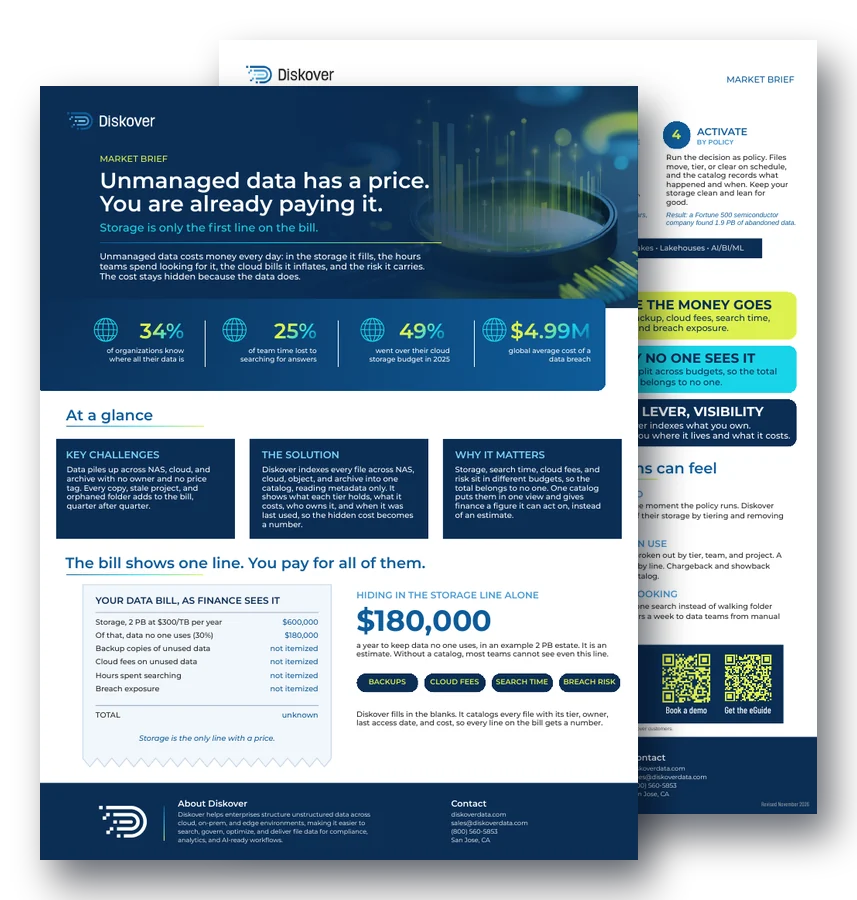
34%
of organizations know where all their data is
25%
of team time lost to searching for answers
49%
went over their cloud storage budget in 2025
$4.99M
global average cost of a data breach
At a glance.
Key challenges.
Data piles up across NAS, cloud, and archive with no owner and no price tag. Every copy, stale project, and orphaned folder adds to the bill, quarter after quarter.
The solution.
Diskover indexes every file across NAS, cloud, object, and archive into one catalog, reading metadata only. It shows what each tier holds, what it costs, who owns it, and when it was last used, so the hidden cost becomes a number.
Why it matters.
Storage, search time, cloud fees, and risk sit in different budgets, so the total belongs to no one. One catalog puts them in one view and gives finance a figure it can act on, instead of an estimate.
The bill shows one line. You pay for all of them.
The storage line.
In an example 2 PB estate at $300 per TB per year, storage costs $600,000 a year. If 30% of that data is unused, $180,000 a year goes to keeping data no one uses.
The lines with no price.
Backup copies of unused data, cloud fees on unused data, hours spent searching, and breach exposure are real costs that are not itemized, so the total stays unknown.
Price every file.
Diskover catalogs every file with its tier, owner, last access date, and cost, so every line on the bill gets a number. Without a catalog, most teams cannot see even the storage line.
Ask in plain language.
Connect your own AI tools through the AI Connector, ask which data costs the most to keep, and get the matching files back with a recommended action. AI-assisted, human-approved.
How it works.
1. Connect
STORAGE OR IT TEAM
Point Diskover at your storage. Distributed indexers read metadata from each system you give them, at whatever scale it runs.
Example: a 2 PB NAS estate is indexed where it sits.
2. Catalog
AUTOMATION
Every file lands in one searchable catalog with rich metadata, such as owner, size, location, and last access date. Each tier carries its cost, so every file has a price.
Example: a project share now shows its owner, age, and cost.
3. Curate
STORAGE AND FINANCE
Rank what is duplicate, stale, orphaned, or abandoned by what it costs to keep. Decide what stays, what moves to a cheaper tier, and what retires, with the evidence attached.
Example: shares untouched for 3 years, ranked by cost to keep.
4. Activate
BY POLICY
Run the decision as policy. Files move, tier, or clear on schedule, and the catalog records what happened and when.
Result: a Fortune 500 semiconductor company found 1.9 PB of abandoned data.
Where the cost of unmanaged data hides.
Unmanaged data never shows up as one line item. It is spread across storage invoices, cloud fees, backup windows, hours lost to searching, and the exposure of files no one owns. CTERA’s scan of 856 file shares found that 88% of files had not been accessed in over a year. That data still sits on paid capacity, still gets backed up, and still widens the attack surface.
Where the money goes
Storage, backup, cloud fees, search time, and breach exposure.
Why no one sees it
The cost is split across budgets, so the total belongs to no one.
Your lever
Visibility. Diskover indexes what you own, and the data tells you where it lives and what it costs.
Common use cases.
Price the estate.
Attach a cost to every share, project, and team, so storage conversations start from a number instead of a guess.
Cut cloud surprises.
Find cold and duplicate data before it moves to the cloud, so fees are paid only on data worth keeping. Wasabi reports that 50% of cloud storage spending goes to fees.
Shrink the risk surface.
Find orphaned and forgotten files with no owner, and decide what to keep, secure, or retire before an audit or an incident forces the question.
Outcomes teams can feel.
Lower storage spend.
Reclaimed space is available the moment the policy runs. Diskover customers reclaim 30 to 50% of their storage by tiering and removing ROT data.
A number finance can use.
The cost of unmanaged data, broken out by tier, team, and project. Chargeback and showback reports build from the same catalog.
Fewer hours spent looking.
Teams find what they need in one search instead of walking folder trees. Diskover returns 30+ hours a week to data teams from manual data housekeeping.
Questions people ask.
What does unmanaged data cost a company?
More than the storage line. Unused data also adds backup copies, cloud fees, hours spent searching, and breach exposure. Take an example 2 PB estate spread across on-premises, cloud, and archive storage, at a blended average of $300 per TB per year. If 30% of that data is unused, it costs about $180,000 a year in storage alone. To do your own calculation, use the cost worksheet in The Cheapest Petabyte eGuide.
Why is the cost of unmanaged data so hard to see?
The cost is split across storage, backup, cloud, and security budgets, so the total belongs to no one. Without a catalog, most teams cannot even see which files are unused.
How does Diskover put a price on our data?
Diskover catalogs every file with its tier, owner, last access date, and cost, so you can break the cost out by tier, team, and project, and build chargeback or showback reports.
How much can we save?
Diskover customers reclaim 30 to 50% of their storage by tiering and removing ROT data, and get 30+ hours a week back from manual data housekeeping.
How often does Diskover update the catalog?
Diskover indexes storage by volume, and you decide the indexing schedule for each one, based on its size and on how often its files change. Active project volumes are often re-indexed every 10 to 30 minutes, while backup and archive volumes are usually re-indexed once a week or once a month.
Related resources.
Sources: 34%: Thales, February 2026. 25%: Atlassian, 2025. 49% and 50%: Wasabi, 2026. $4.99M: IBM, July 2026. 88%: CTERA, September 2026. 30 to 50% and 30+ hours: Diskover customers.
See it on your own data.
We’ll index a sample of your environment and show you
what’s recoverable against your current storage spend.