


DATASHEET | DATADISCOVERY
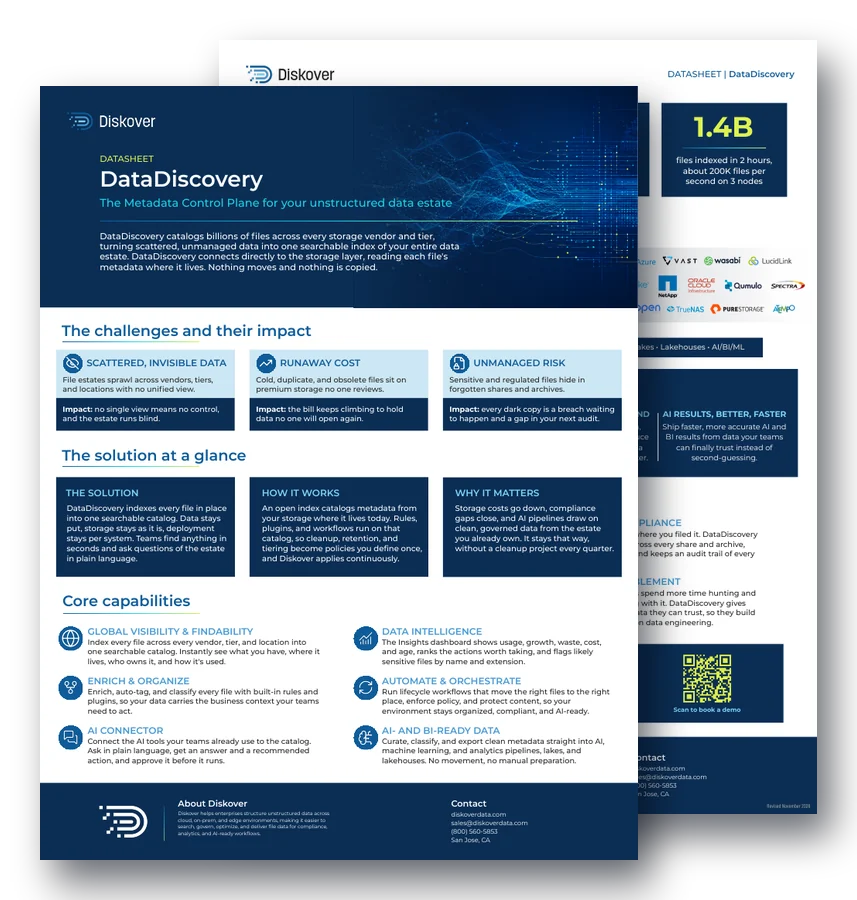
DataDiscovery: the Metadata Control Plane for your unstructured data estate.
DataDiscovery catalogs billions of files across every storage vendor and tier into one searchable enriched metadata catalog. The data stays where it is while the catalog is built.
30-50%
of storage reclaimed by tiering and removing ROT data
435+
platform features, including 55+ plugins
40+
API endpoints for open, no-lock-in integration
1.4B
files indexed in 2 hours, about 200K files per second on 3 nodes
At a glance.
The challenge.
File estates sprawl across vendors, tiers, and locations with no unified view. Cold, duplicate, and obsolete files sit on premium storage no one reviews, and sensitive files hide in forgotten shares and archives.
The solution.
DataDiscovery indexes every file in place into one searchable catalog. Data stays put, storage stays as it is, and teams find anything in seconds or ask questions of the estate in plain language.
Why it matters.
Storage costs go down, compliance gaps close, and AI pipelines draw on clean, governed data from the estate you already own. Cleanup, retention, and tiering become policies you define once, and Diskover applies them continuously.
Core capabilities.
Global visibility and findability.
Index every file across every vendor, tier, and location into one searchable catalog. See what you have, where it lives, who owns it, and how it is used.
Data intelligence.
The Insights dashboard shows usage, growth, waste, cost, and age, ranks the actions worth taking, and flags likely sensitive files by name and extension.
Enrich and organize.
Enrich, auto-tag, and classify every file with built-in rules and plugins, so your data carries the business context your teams need to act.
Automate and orchestrate.
Run lifecycle workflows that move the right files to the right place, enforce policy, and protect content, so your environment stays organized, compliant, and AI-ready.
AI Connector.
Connect the AI tools your teams already use to the catalog with the AI Connector. Ask in plain language, get an answer and a recommended action, and approve it before it runs.
AI- and BI-ready data.
Curate, classify, and export clean metadata straight into AI and analytics pipelines, lakes, and lakehouses. No movement, no manual preparation.
How it works.
1. Connect
STORAGE OR IT TEAM
DataDiscovery connects directly to the storage you already run, across cloud, on-prem, hybrid, NAS, SAN, object, tape, and archive.
Example: a NAS share is cataloged where it sits.
2. Catalog
AUTOMATION
An open, Elasticsearch-based index catalogs each file’s metadata where it lives. Plugins enrich every record in the same pass.
Example: a project file now shows its owner, age, and usage.
3. Curate
ANY AUTHORIZED TEAM
Search, tag, and classify files, and build saved searches for what teams ask every week, such as cold data on premium storage or likely sensitive files outside approved shares.
Example: a data manager saves “cold files on premium storage”.
4. Activate
BY POLICY
Cleanup, retention, and tiering run as policies you define once, and curated metadata flows to analytics and AI through the API.
Result: storage costs go down and stay down.
Outcomes teams can measure.
Lower spend.
Reclaim capacity and budget by acting on cold, duplicate, and obsolete files, often 30% to 50% of storage.
Hours back to your team.
Replace ticket-driven file hunts and manual cleanup with plain language search and automated workflows.
Audit-ready, on demand.
Locate likely sensitive data, enforce retention, and produce audit reports the moment a regulator asks, not weeks later.
AI results, better and faster.
Ship faster, more accurate AI and BI results from data your teams can finally trust.
Questions people ask.
What is DataDiscovery?
DataDiscovery is the part of the Diskover platform that catalogs billions of files across every storage vendor and tier into one searchable metadata catalog, with the data staying in place.
Does DataDiscovery move my files to build the catalog?
No. It reads each file’s metadata where it lives, such as name, path, owner, size, and age. The data stays in place while the catalog is built, and moves only when a workflow calls for it.
Which storage does DataDiscovery work with?
It works across cloud, on-prem, and hybrid storage, including NAS, SAN, object, tape, and archive, plus data lakes and lakehouses.
How does DataDiscovery help with storage costs?
It finds the cold, duplicate, and misplaced data behind the storage bill and clears it by policy. Teams often reclaim 30% to 50% of storage by tiering and removing ROT data.
How often does Diskover update the catalog?
Diskover indexes storage by volume, and you decide the indexing schedule for each one, based on its size and on how often its files change. Active project volumes are often re-indexed every 10 to 30 minutes, while backup and archive volumes are usually re-indexed once a week or once a month. Rescans are faster than the first index, about 500,000 to 600,000 files per second, because Diskover skips folders that have not changed.
Related resources.
See it on your own data.
We’ll index a sample of your environment and show you
what’s recoverable against your current storage spend.