


MARKET BRIEF | AI-READY DATA
Every file you send to AI has a price.
Curate first, and pay only for the data that matters. Most AI projects point a model at a whole file share, and pay to store, move, and process every duplicate, old version, and temp file in it.
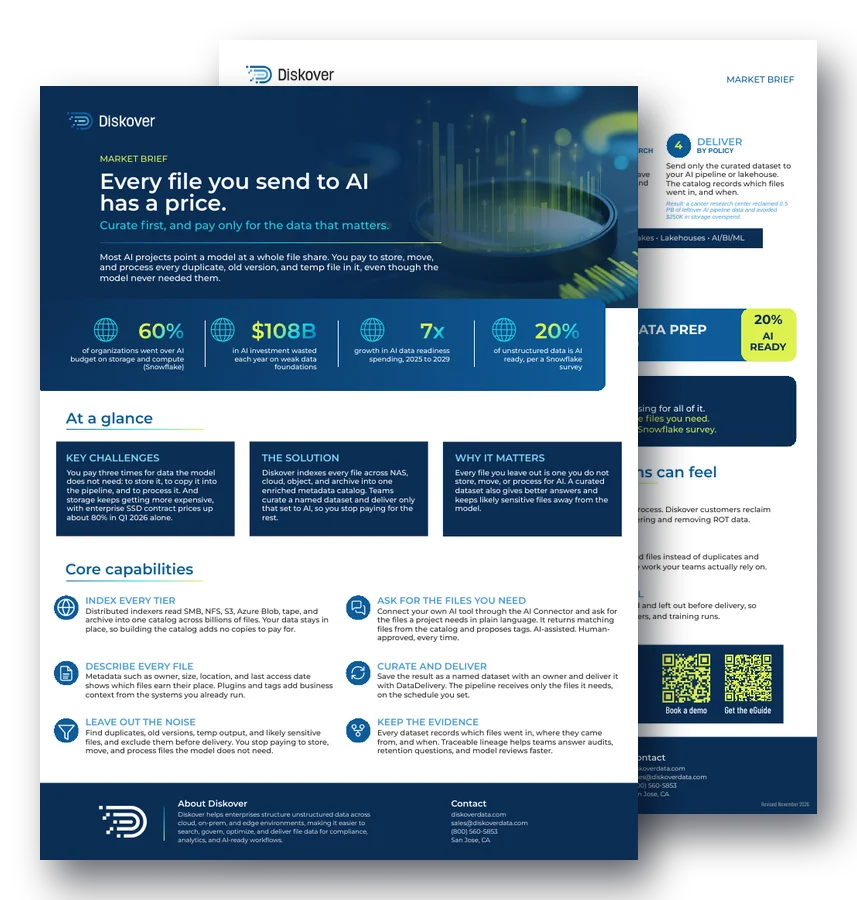
60%
of organizations went over AI budget on storage and compute
$108B
in AI investment wasted each year on weak data foundations
7x
growth in AI data readiness spending, 2025 to 2029
20%
of unstructured data is AI ready, per a Snowflake survey
At a glance.
Key challenges.
You pay three times for data the model does not need: to store it, to copy it into the pipeline, and to process it. Storage also keeps getting more expensive, with enterprise SSD contract prices up about 80% in Q1 2026 alone.
The solution.
Diskover indexes every file across NAS, cloud, object, and archive into one enriched metadata catalog. Teams curate a named dataset and deliver only that set to AI, so you stop paying for the rest.
Why it matters.
Every file you leave out is one you do not store, move, or process for AI. A curated dataset also gives better answers and keeps likely sensitive files away from the model.
Core capabilities.
Index every tier.
Distributed indexers read SMB, NFS, S3, Azure Blob, tape, and archive into one catalog across billions of files. Your data stays in place, so building the catalog adds no copies to pay for.
Ask for the files you need.
Connect your own AI tool through the AI Connector and ask for the files a project needs in plain language. It returns matching files from the catalog and proposes tags. AI-assisted, human-approved.
Describe every file.
Rich metadata, such as owner, size, location, and last access date, shows which files earn their place. Plugins and tags add business context from the systems you already run.
Curate and deliver.
Save the result as a named dataset with an owner and deliver it with DataDelivery. The pipeline receives only the files it needs, on the schedule you set.
Leave out the noise.
Find duplicates, old versions, temp output, and likely sensitive files, and exclude them before delivery. You stop paying to store, move, and process files the model does not need.
Keep the evidence.
Every dataset records which files went in, where they came from, and when. Traceable lineage helps teams answer audits, retention questions, and model reviews faster.
How it works.
1. Connect
ANY STORAGE
Point Diskover at your storage. Distributed indexers read metadata from each system you give them.
Example: a 2 PB NAS estate is indexed where it sits.
2. Catalog
AUTOMATION
Every file lands in one searchable catalog with rich metadata, such as owner, size, location, and last access date.
Example: a project share now shows its owner, age, and size.
3. Curate
AI CONNECTOR OR SEARCH
Search the catalog or ask through the AI Connector. Leave out duplicates, old versions, and likely sensitive files.
Example: only current, owned files for one project make the dataset.
4. Deliver
BY POLICY
Send only the curated dataset to your AI pipeline or lakehouse. The catalog records which files went in, and when.
Result: a cancer research center reclaimed 0.5 PB of leftover AI pipeline data and avoided $250K in storage overspend.
What you send to AI versus what it needs.
Most AI projects start by pointing a model at a whole file share. You pay to store it, to copy it into the pipeline, and to process it, and the model reads the duplicates, drafts, and old versions as if they were all true. Diskover reverses the order. It describes every file from metadata alone, lets teams decide what belongs, and delivers only that set.
Without data prep
Everything goes in. You pay for storage, transfer, and processing for all of it.
Curated first
You pay for transfer and processing for only the files you need.
AI ready today
Only 20% of unstructured data is AI ready, per a Snowflake survey.
Common use cases.
Curate training data.
Select the files that match a training need, such as recordings from a given condition or instrument, and leave out the rest, so the model learns from the right examples.
Feed the lakehouse.
Send a curated, described dataset to Snowflake or another lakehouse, so analysts and AI tools query one catalog instead of many shares.
Clear the AI pipeline.
Find the checkpoints, temporary output, and old training runs that collect around AI projects, and recover the premium storage they occupy.
Outcomes teams can feel.
Lower AI costs.
Less data to store, move, and process. Diskover customers reclaim 30 to 50% of their storage by tiering and removing ROT data.
Better answers.
The model reads current, owned files instead of duplicates and drafts, so its answers reflect the work your teams rely on.
Less risk in the model.
Likely sensitive files are flagged and left out before delivery, so they stay out of prompts, answers, and training runs.
Questions people ask.
Why do AI projects cost more than expected?
Most projects point a model at a whole file share, so you pay to store, copy, and process every duplicate, old version, and temp file in it. 60% of organizations went over their AI budget on storage and compute, according to a Snowflake survey.
What does it mean to curate data for AI?
Curating means choosing the files a project needs, such as current, owned files for one project, and leaving out duplicates, old versions, and likely sensitive files before anything reaches the model.
Does Diskover copy my data to build the catalog?
No. Diskover reads metadata only, such as owner, size, location, and last access date. Your data stays in place, so building the catalog adds no copies to pay for.
How does a curated dataset reach the AI pipeline?
Teams save the result as a named dataset with an owner, and DataDelivery sends only those files to the AI pipeline or lakehouse on the schedule you set. The catalog records which files went in, and when.
How can I estimate what my AI data costs?
Use the cost worksheet in The Cheapest Petabyte eGuide for a quick estimate, or size it on your own data with a 30-day proof of concept.
Related resources.
Sources: 60% and 20%: Snowflake (Omdia), March 2026. $108B: Hitachi Vantara, January 2026. 7x: Gartner, March 2026. SSD prices: TrendForce, June 2026. 30 to 50%: Diskover customers.
See it on your own data.
We’ll index a sample of your environment and show you
what’s recoverable against your current storage spend.