


CUSTOMER SUCCESS STORY | ENERGY
Energy producer turns deal data from liability to asset.
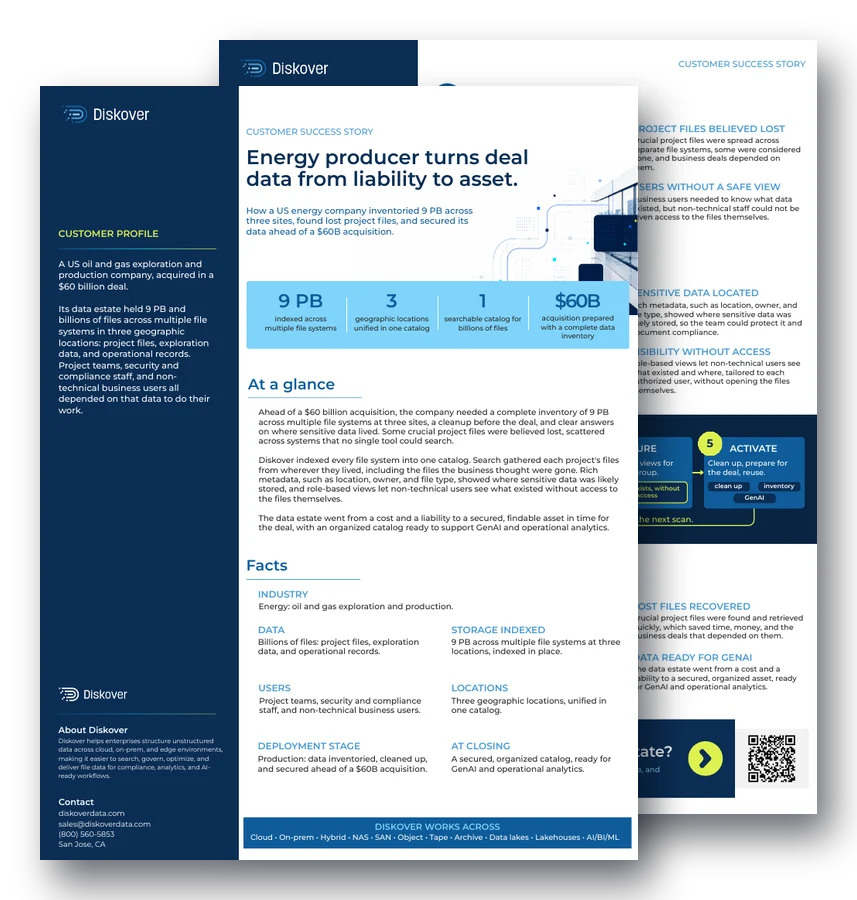
How a US energy company inventoried 9 PB across three sites, found lost project files, and secured its data ahead of a $60B acquisition.
9 PB
indexed across multiple file systems
3
geographic locations unified in one catalog
1
searchable catalog for billions of files
$60B
acquisition prepared with a complete data inventory
At a glance.
Ahead of a $60 billion acquisition, the company needed a complete inventory of 9 PB across multiple file systems at three sites, a cleanup before the deal, and clear answers on where sensitive data lived. Some crucial project files were believed lost, scattered across systems that no single tool could search.
Diskover indexed every file system into one catalog. Search gathered each project’s files from wherever they lived, including the files the business thought were gone. Rich metadata, such as location, owner, and file type, showed where sensitive data was likely stored, and role-based views let non-technical users see what existed without access to the files themselves.
The data estate went from a cost and a liability to a secured, findable asset in time for the deal, with an organized catalog ready to support GenAI and operational analytics, the start of AI-ready data. Read how Diskover supports mergers and acquisitions.
Customer profile
A US oil and gas exploration and production company, acquired in a $60 billion deal.
Its data estate held 9 PB and billions of files across multiple file systems in three geographic locations: project files, exploration data, and operational records.
Project teams, security and compliance staff, and non-technical business users all depended on that data to do their work.
Data
Billions of files: project files, exploration data, and operational records.
Storage indexed
9 PB across multiple file systems at three locations, indexed in place.
Users
Project teams, security and compliance staff, and non-technical business users.
Locations
Three geographic locations, unified in one catalog.
Challenges.
A deal needed an inventory.
A $60 billion acquisition required the entire data estate to be inventoried, cleaned up, and secured before the transaction.
Project files believed lost.
Crucial project files were spread across separate file systems, some were considered gone, and business deals depended on them.
Sensitive data untracked.
The team could not pinpoint where sensitive data lived, which made it hard to protect it and show compliance.
Users without a safe view.
Business users needed to know what data existed, but non-technical staff could not be given access to the files themselves.
Solutions.
One catalog for 9 PB.
Diskover indexed every file system at all three locations into one searchable catalog of billions of files, with the data staying in place.
Sensitive data located.
Rich metadata, such as location, owner, and file type, showed where sensitive data was likely stored, so the team could protect it and document compliance.
Every project, gathered.
Search pulled each project’s files together across file systems and surfaced the crucial files the business believed were lost, in time for the deal.
Visibility without access.
Role-based views let non-technical users see what existed and where, tailored to each authorized user, without opening the files themselves.
“In an acquisition, every file is part of the deal, and the buyer will ask about it. A complete inventory lets a company answer with facts: what it has, where it lives, and who should see it.”
Paul Honrud, CPO, Diskover
How it works.
1. Index
All three sites indexed in place.
2. Organize
Files grouped by project across file systems.
3. Find
Lost project files, likely sensitive data, and cleanup candidates, across every system.
4. Secure
Role-based views for each user group.
5. Activate
Clean up, prepare for the deal, and reuse.
Files stay in place while the catalog is built. The catalog updates on the next scan.
Outcomes.
Deal-ready data.
A complete, current inventory of 9 PB across three locations was ready ahead of the $60 billion acquisition.
Lost files recovered.
Crucial project files were found and retrieved quickly, which saved time, money, and the business deals that depended on them.
Risk under control.
Visibility across all three locations let the team protect likely sensitive data and manage risk and cost proactively.
Data ready for GenAI.
The data estate went from a cost and a liability to a secured, organized asset, ready for GenAI and operational analytics.
Questions people ask.
Why does an acquisition need a complete data inventory?
Every file is part of the deal, and the buyer will ask about it. A complete inventory shows what the company has, where it lives, and who should see it, so data questions get answered with facts instead of estimates.
How do you find project files that seem lost?
Index every file system into one catalog, then search across all of them at once. Search gathered each project’s files from wherever they lived, including files the business believed were gone. Explore data discovery.
How did this energy company locate sensitive data without opening files?
Diskover used rich metadata, such as location, owner, and file type, to show where sensitive data was likely stored. Diskover works from metadata and never reads file contents.
Can non-technical users see the data without accessing the files?
Yes. Role-based views showed non-technical users what existed and where, tailored to each authorized user, without opening the files themselves.
How much data did this energy producer index?
9 PB and billions of files across multiple file systems in three geographic locations, indexed in place into one searchable catalog ahead of a $60 billion acquisition.
Related resources.
See it on your own data.
We’ll index a sample of your environment and show you
what’s recoverable against your current storage spend.