


CUSTOMER SUCCESS STORY | MEDIA AND ENTERTAINMENT
Entertainment leader reclaims 8 PB, saves $10M.
How a $180B entertainment leader indexed 260 PB across six data centers, found its redundant and outdated media, and cleared 8 PB.
260 PB
of media indexed into one catalog
8 PB
reclaimed across six data centers
$10M
saved on storage spend
$20M+
in CapEx savings
At a glance.
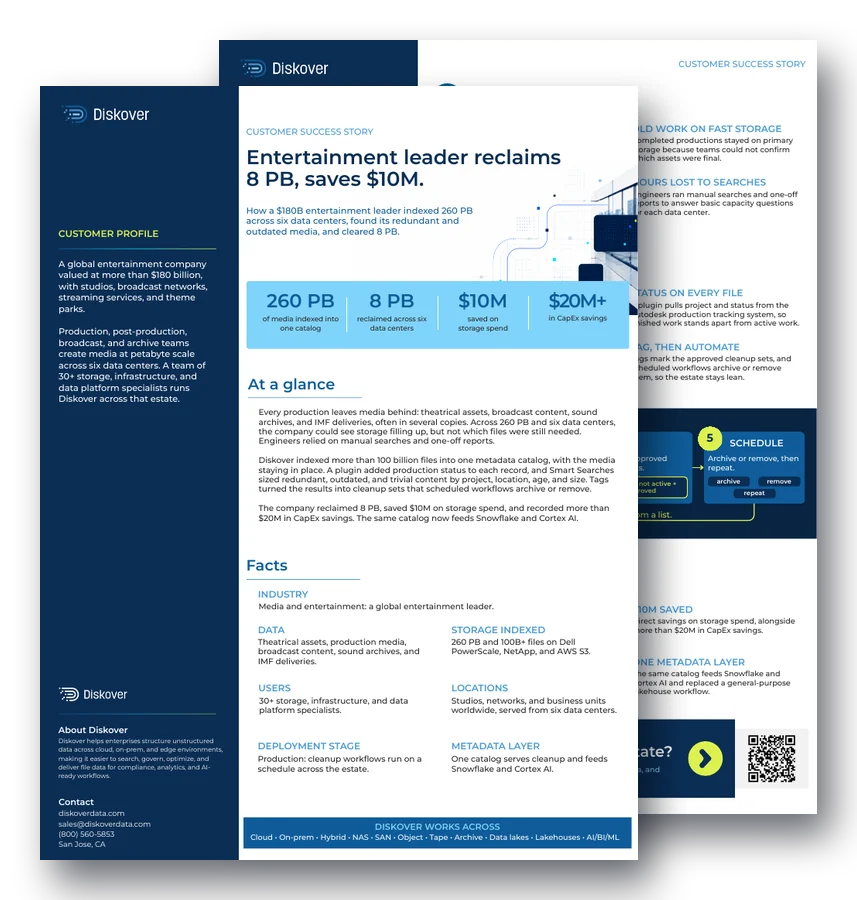
Every production leaves media behind: theatrical assets, broadcast content, sound archives, and IMF deliveries, often in several copies. Across 260 PB and six data centers, the company could see storage filling up, but not which files were still needed. Engineers relied on manual searches and one-off reports.
Diskover indexed more than 100 billion files into one metadata catalog, with the media staying in place. A plugin added production status to each record, and Smart Searches sized redundant, outdated, and trivial content by project, location, age, and size. Tags turned the results into cleanup sets that scheduled workflows archive or remove.
The company reclaimed 8 PB, saved $10M on storage spend, and recorded more than $20M in CapEx savings. The same catalog now feeds Snowflake and Cortex AI.
Customer profile
A global entertainment company valued at more than $180 billion, with studios, broadcast networks, streaming services, and theme parks.
Production, post-production, broadcast, and archive teams create media at petabyte scale across six data centers.
A team of 30+ storage, infrastructure, and data platform specialists runs Diskover across that estate.
Data
Theatrical assets, production media, broadcast content, sound archives, and IMF deliveries.
Storage indexed
260 PB and 100B+ files on Dell PowerScale, NetApp, and AWS S3.
Users
30+ storage, infrastructure, and data platform specialists.
Locations
Studios, networks, and business units worldwide, served from six data centers.
Challenges.
Six sites, no shared view.
Media sat across six data centers and several file systems, with no single inventory of what existed, where, or how old.
Old work on fast storage.
Completed productions stayed on primary storage because teams could not confirm which assets were final.
Copies with every release.
Duplicates, transcodes, and outdated versions built up with each release, and storage spend grew faster than the library.
Hours lost to searches.
Engineers ran manual searches and one-off reports to answer basic capacity questions for each data center.
Solutions.
One catalog, 260 PB.
Diskover indexed more than 100 billion files across six data centers into one catalog, from metadata only, with media in place.
Status on every file.
A plugin pulls project and status from the Autodesk production tracking system, so finished work stands apart from active work.
Searches that size waste.
Saved searches on fields such as project, location, age, and size measured the reclaimable content in each data center.
Tag, then automate.
Tags mark the approved cleanup sets, and scheduled workflows archive or remove them, so the estate stays lean. See curation and orchestration.
“Every storage leader knows the waste and inefficiencies exist. The challenge is quantifying them. Diskover gives them a number they can defend to the CFO – and the insight and confidence to act.”
Tony Chidiac, CRO, Diskover
How it works.
1. Index
Six data centers, 260 PB, indexed in place.
2. Catalog
100B+ files, with production status.
3. Search
Finished productions, duplicates, and outdated versions, by project, location, age, and size.
4. Tag
Mark the approved cleanup sets.
5. Schedule
Archive or remove, then repeat.
Active productions stay on fast storage. Every cleanup starts from a list.
Outcomes.
8 PB reclaimed.
Redundant, outdated, and trivial media cleared across six data centers, returning capacity to active productions.
$10M saved.
Direct savings on storage spend, alongside more than $20M in CapEx savings.
Hours back to engineering.
Hundreds of engineering hours recovered each year, as capacity questions became saved searches.
One metadata catalog.
The same catalog feeds Snowflake and Cortex AI and replaced a general-purpose lakehouse workflow.
Questions people ask.
Why do media companies run out of storage so fast?
Every production leaves media behind, often in several copies: duplicates, transcodes, and outdated versions build up with each release. Completed work stays on primary storage when teams cannot confirm which assets are final, so spend grows faster than the library.
How do you find which media files are still needed?
Add production status to each file’s record and search by project, location, age, and size. Here, a plugin pulled status from the production tracking system, so finished work stood apart from active work. Explore storage reclamation.
How did this entertainment leader reclaim 8 PB?
Diskover indexed 260 PB and more than 100 billion files across six data centers. Saved searches sized redundant, outdated, and trivial content, tags marked the approved cleanup sets, and scheduled workflows archived or removed them.
Does Diskover move or copy media to build the catalog?
No. Diskover indexes the media in place and builds the catalog from metadata only. Files move only when a scheduled workflow archives or removes an approved cleanup set.
Can the same catalog serve cleanup and AI?
Yes. At this company, the catalog that drives cleanup also feeds Snowflake and Cortex AI, and it replaced a general-purpose lakehouse workflow.
Related resources.
See it on your own data.
We’ll index a sample of your environment and show you
what’s recoverable against your current storage spend.