


DATASHEET | DISKOVER + CLOUDREPLICA
Every subsurface file, in one global view.
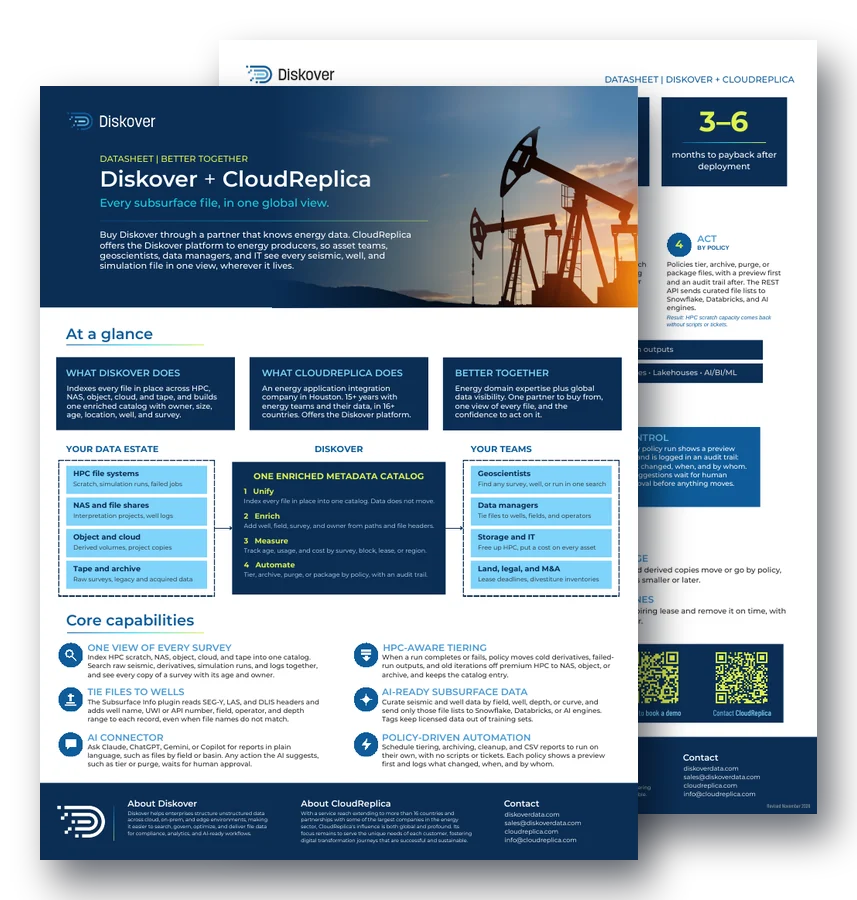
Buy Diskover through a partner that knows energy data. CloudReplica offers the Diskover platform to energy producers, so asset teams, geoscientists, data managers, and IT see every seismic, well, and simulation file in one enriched metadata catalog.
9 PB
inventoried for a $60B oil and gas merger
30%+
of HPC capacity reclaimed in oil and gas
$1.5M
storage savings at a global energy company
3-6
months to payback after deployment
At a glance.
What Diskover does.
Indexes every file in place across HPC, NAS, object, cloud, and tape, and builds one enriched catalog with owner, size, age, location, well, and survey.
What CloudReplica does.
An energy application integration company in Houston, with 15+ years working with energy teams and their data in 16+ countries. CloudReplica offers the Diskover platform.
Better together.
Energy domain expertise plus global data visibility. One partner to buy from, one view of every file, and the confidence to act on it.
Core capabilities.
One view of every survey.
Index HPC scratch, NAS, object, cloud, and tape into one catalog. Search raw seismic, derivatives, simulation runs, and logs together, and see every copy of a survey with its age and owner.
HPC-aware tiering.
When a run completes or fails, policy moves cold derivatives, failed-run outputs, and old iterations off premium HPC to NAS, object, or archive, and keeps the catalog entry.
Tie files to wells.
The Subsurface Info plugin reads SEG-Y, LAS, and DLIS headers and adds well name, UWI or API number, field, operator, and depth range to each record, even when file names do not match.
AI-ready subsurface data.
Curate seismic and well data by field, well, depth, or curve, and send only those file lists to Snowflake, Databricks, or AI engines. Tags keep licensed data out of training sets.
AI Connector.
Ask Claude, ChatGPT, Gemini, or Copilot for reports in plain language through the AI Connector, such as files by field or basin. Any action the AI suggests waits for human approval.
Policy-driven automation.
Schedule tiering, archiving, cleanup, and CSV reports to run on their own, with no scripts or tickets. Each policy shows a preview first and logs what changed, when, and by whom.
How it works.
1. Index
STORAGE OR IT TEAM
Point Diskover at HPC file systems, NAS, object, cloud, and tape. Parallel workers scan in place, and rescans skip folders that have not changed.
Example: 1.4 billion files indexed in two hours, about 200K files per second.
2. Enrich
AUTOMATION
Every file becomes a record with path, owner, size, and dates. The Subsurface Info plugin adds well, UWI, field, operator, and depth range from file headers.
Example: a .las file now shows its well, field, operator, and depth range.
3. Curate
ANY AUTHORIZED TEAM
Search any field with Quick Search or Lucene, save searches, and tag files by survey, lease, or status. Or ask the AI Connector: it proposes, a person approves.
Example: a data manager saves “failed runs still on HPC scratch”.
4. Act
BY POLICY
Policies tier, archive, purge, or package files, with a preview first and an audit trail after. The REST API sends curated file lists to Snowflake, Databricks, and AI engines.
Result: HPC scratch capacity comes back without scripts or tickets.
Deployment and security.
Deployment
Runs on premises, in the cloud, hybrid, or at air-gapped sites. Indexing runs where the data lives, and nothing is recalled from tape.
Metadata only
Reads file attributes and headers only: the first 3,600 bytes of SEG-Y, LAS headers up to 1 MiB, and DLIS metadata. Trace and curve data are never read.
Control
Every policy run shows a preview first and is logged in an audit trail. AI suggestions wait for human approval before anything moves.
Recognizes
SEG-Y, SEG-D, ZGY, LAS, DLIS, P1/90, and simulation outputs.
Business outcomes.
Global visibility.
See every seismic, well, and simulation file across sites, countries, and storage systems in one view, with its owner, age, and cost.
Reclaim HPC storage.
Old projects, failed runs, and derived copies move or go by policy, so the next HPC purchase is smaller or later.
Close deals with confidence.
Get a full inventory of what an acquisition brings, or what a joint venture exit takes with it.
Meet lease deadlines.
Find every file tied to an expiring lease and remove it on time, with proof ready for the regulator.
Questions people ask.
Who is CloudReplica?
CloudReplica is an energy application integration company in Houston, with 15+ years working with energy teams and their data in 16+ countries. CloudReplica offers the Diskover platform to energy producers.
Does Diskover read seismic traces or well log curves?
No. It reads file attributes and headers only: the first 3,600 bytes of SEG-Y, LAS headers up to 1 MiB, and DLIS metadata. Trace and curve data are never read.
Can Diskover run at air-gapped sites?
Yes. Diskover runs on premises, in the cloud, hybrid, or at air-gapped sites, and indexing runs where the data lives.
How does Diskover reclaim HPC storage?
When a run completes or fails, policy moves cold derivatives, failed-run outputs, and old iterations off premium HPC to NAS, object, or archive, and keeps the catalog entry.
How do I start with CloudReplica?
Start with a 30-day proof of concept on your own subsurface data through CloudReplica. Diskover customers typically see payback 3 to 6 months after deployment.
Related resources.
See it on your own data.
We’ll index a sample of your environment and show you
what’s recoverable against your current storage spend.