


CUSTOMER SUCCESS STORY | LIFE SCIENCE
Half a petabyte found in hours. $542K reclaimed in days.
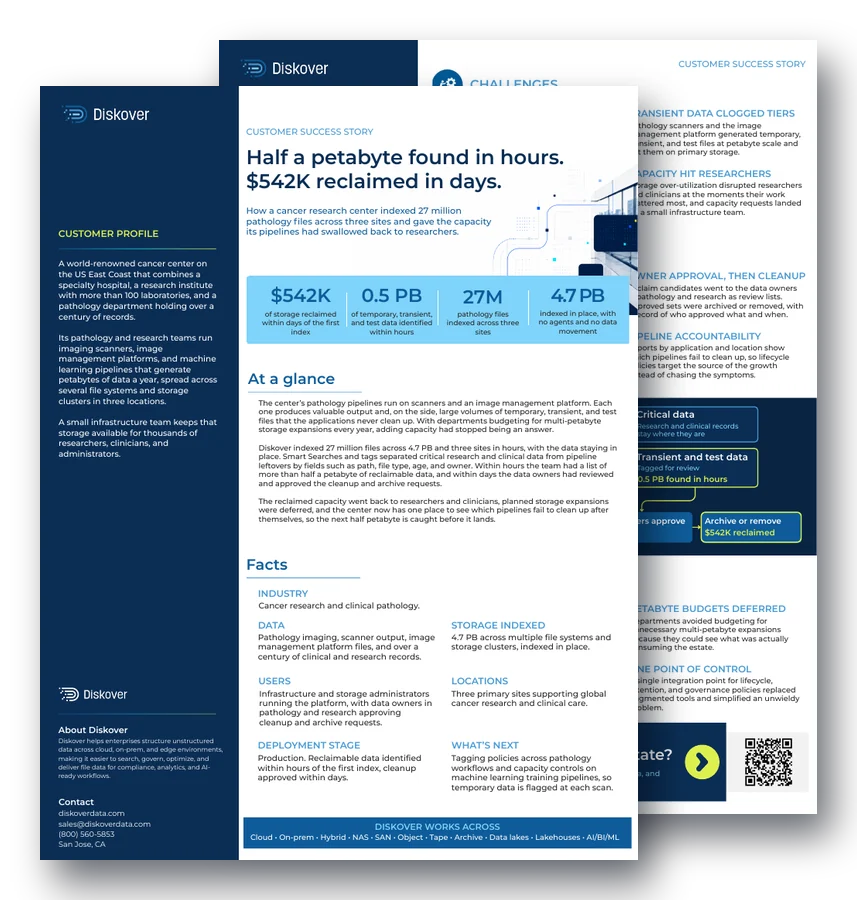
How a cancer research center indexed 27 million pathology files across three sites and gave the capacity its pipelines had swallowed back to researchers.
$542K
of storage reclaimed within days of the first index
0.5 PB
of temporary, transient, and test data identified within hours
27M
pathology files indexed across three sites
4.7 PB
indexed in place, with no agents and no data movement
At a glance.
The center’s pathology pipelines run on scanners and an image management platform. Each one produces valuable output and, on the side, large volumes of temporary, transient, and test files that the applications never clean up. With departments budgeting for multi-petabyte storage expansions every year, adding capacity had stopped being an answer.
Diskover indexed 27 million files across 4.7 PB and three sites in hours, with the data staying in place. Smart Searches and tags separated critical research and clinical data from pipeline leftovers by fields such as path, file type, age, and owner. Within hours the team had a list of more than half a petabyte of reclaimable data, and within days the data owners had reviewed and approved the cleanup and archive requests.
The reclaimed capacity went back to researchers and clinicians, planned storage expansions were deferred, and the center now has one place to see which pipelines fail to clean up after themselves, so the next half petabyte is caught before it lands. Explore storage reclamation.
Customer profile
A world-renowned cancer center on the US East Coast that combines a specialty hospital, a research institute with more than 100 laboratories, and a pathology department holding over a century of records.
Its pathology and research teams run imaging scanners, image management platforms, and machine learning pipelines that generate petabytes of data a year, spread across several file systems and storage clusters in three locations.
A small infrastructure team keeps that storage available for thousands of researchers, clinicians, and administrators.
Data
Pathology imaging, scanner output, image management platform files, and over a century of clinical and research records.
Storage indexed
4.7 PB across multiple file systems and storage clusters, indexed in place.
Users
Infrastructure and storage administrators, with data owners in pathology and research approving cleanup and archive requests.
Locations
Three primary sites supporting global cancer research and clinical care.
Challenges.
Petabyte-scale growth.
Departments were budgeting for multi-petabyte storage expansions every year, with no view of how much of that growth was research data and how much was pipeline leftovers.
Transient data clogged tiers.
Pathology scanners and the image management platform generated temporary, transient, and test files at petabyte scale and left them on primary storage.
No view across the estate.
Building a picture of storage and data across several file systems, clusters, and three sites was slow, manual, and error-prone, so decisions ran on estimates.
Capacity hit researchers.
Storage over-utilization disrupted researchers and clinicians at the moments their work mattered most, and capacity requests landed on a small infrastructure team.
Solutions.
Rapid index, full estate.
Diskover indexed 27 million files across 4.7 PB and three sites in hours, from metadata only, with no agents on storage and no data movement.
Owner approval, then cleanup.
Reclaim candidates went to the data owners in pathology and research as review lists. Approved sets were archived or removed, with a record of who approved what and when.
Smart Searches and tagging.
Saved searches on fields such as path, file type, age, and owner separated research and clinical data from scanner output and platform temp files.
Pipeline accountability.
Reports by application and location show which pipelines fail to clean up, so lifecycle policies target the source of the growth instead of chasing the symptoms.
“Pathology pipelines are built to produce results, not to clean up after themselves. Seeing this team find half a petabyte of leftovers within hours of their first index, and get it approved for cleanup within days, is exactly why we built Diskover around the metadata instead of the files.”
Paul Honrud, CPO, Diskover
Where the half petabyte was hiding.
Scanners
Intermediate output while building slide images.
Image platform
Session and cache files as users work.
Test data
Checkpoints, copies, and test sets every run.
Pipelines produce results, not cleanup. The metadata shows what they leave behind: transient and test data was tagged for review, data owners approved, and the approved sets were archived or removed.
Outcomes.
$542K reclaimed.
More than half a petabyte of reclaimable data identified within hours and approved for cleanup within days, with no migration and no new hardware.
Petabyte budgets deferred.
Departments avoided budgeting for unnecessary multi-petabyte expansions because they could see what was actually consuming the estate.
Hours back to research.
Researchers and clinicians stopped chasing capacity and resumed their work, and the infrastructure team stopped fielding emergency storage requests.
One point of control.
A single integration point for lifecycle, retention, and governance policies replaced fragmented tools and simplified an unwieldy problem.
Questions people ask.
Where does wasted storage hide in pathology and research pipelines?
In the temporary, transient, and test files that scanners, image management platforms, and machine learning pipelines create on the side and never clean up: intermediate output while building slide images, session and cache files, and checkpoints, copies, and test sets.
How fast can Diskover find reclaimable data?
At this cancer center, Diskover indexed 27 million files across 4.7 PB and three sites in hours, and the team had a list of more than half a petabyte of reclaimable data within hours of the first index.
Who approves what gets deleted?
The data owners. Reclaim candidates went to data owners in pathology and research as review lists, and only approved sets were archived or removed, with a record of who approved what and when.
Does Diskover need agents or data movement to index storage?
No. Diskover indexed the center’s estate from metadata only, with no agents on storage and no data movement. It never reads file contents.
How does the center stop the waste from coming back?
Reports by application and location show which pipelines fail to clean up, and tagging policies and capacity controls flag temporary data at each scan, so the next half petabyte is caught before it lands.
Related resources.
See it on your own data.
We’ll index a sample of your environment and show you
what’s recoverable against your current storage spend.