

BLOG | INDUSTRY
The bottleneck in AI drug discovery isn’t compute. It’s locating the relevant data.
August 12, 2026 · 6 min read
Your organization did everything the last two years asked of it.
You stood up the graphics processing unit (GPU) cluster. You hired the machine learning (ML) engineers. You licensed the models. The compute is racked, powered, and waiting. And the discovery program it was bought for is weeks behind schedule, not because the science is a challenge, but because no one can assemble the dataset to train on.
That’s the quiet truth of artificial intelligence (AI) in drug discovery today. The models are ready. The compute is ready. The data is somewhere in your estate, the right cohort, the right assay runs, the right images and you cannot compile.
You bought the compute. You’re still waiting on the data.
The reflex is to treat AI as a compute problem: more GPUs, bigger models, a larger cluster. But the people closest to the work keep landing in the same spot. In one industry review of AI in drug discovery, the conclusion was blunt: the challenge is not data volume but data readiness, and datasets scattered across systems that were never designed to share an index produced unreliable predictions no matter how sophisticated the model.
The numbers agree. Only 14% of leaders describe their data as AI-ready, and 80% of AI initiatives never reach production. Those two figures are the same story told twice: it is not the model that fails. It is the data underneath it.
The numbers agree. Only 7% of enterprises say their data is completely ready for AI, and nearly 80% say AI is held back by data access challenges. Those two figures are the same story told twice: it is not the model that fails. It is the data underneath it.
So ask the question your project plan keeps dodging: if your team had to gather every sample from a single assay, run across three sites and two years, how long would that take? Would you trust that you’d found all of it? For most research organizations, the honest answer is weeks, and no. Those weeks are gone before the first model runs. The project is late before it starts.
Where your best data goes to hide.
Start with the scale. A single next-generation sequencer, cryo-electron microscope, or high-content imaging system generates a torrent of files; raw output, processed results, and every intermediate in between. That data lands on network-attached storage (NAS), spills into the cloud, gets copied to a researcher’s share for a side analysis, archived to cold storage when the study closes, and duplicated again for a collaborator. One experiment becomes a dozen copies scattered across four teams, not lost, simply unaccounted for.
None of it was ever described in a way a machine can search. A file is created every second and labeled almost never, so the estate fills with data whose contents, owner, and value are unknown to everyone but the person who made it, and that person moved to another lab a year ago.
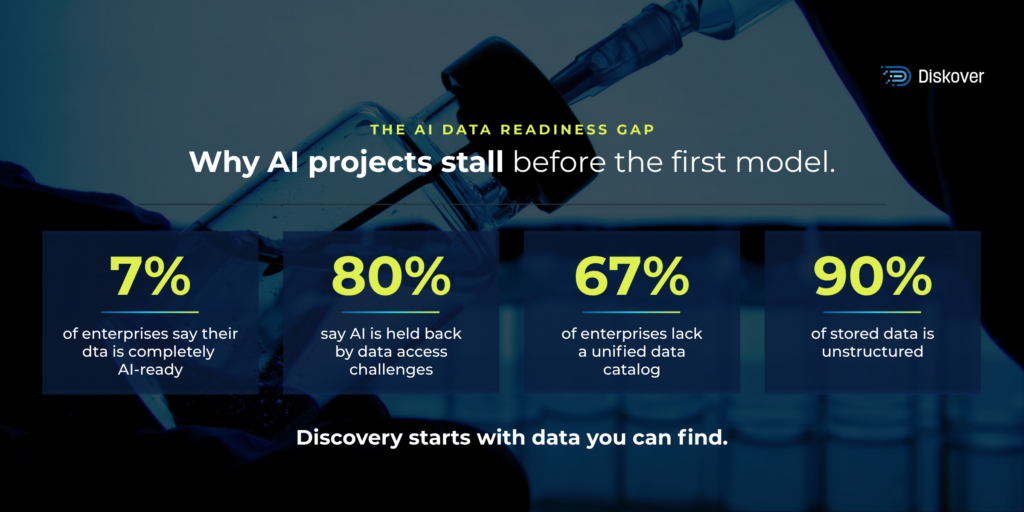
This is why the assembly takes weeks. It is not that the data is gone. It is that 90% of what you store is unstructured, and no one has an inventory of what is in it. The volume keeps climbing, on track to nearly double by 2028. Worse, 67% of enterprises have no unified catalog of any of it. Without that single view, finding the right datasets means emailing the person who created them and hoping they still remember where they went.
Locating the right data is a metadata problem, not a data-science one.
Here is the part that changes the math: you do not need to open a single genomic file to find the right ones. What tells you which files matter is their metadata. The instrument that produced them, the project they belong to, the owner, the date, the assay type, and the enriched attributes a life-science plugin harvests from file headers. Across billions of files, metadata becomes a map of everything you store.
Index that metadata into a single searchable catalog, and “where is every sample from that assay” stops being a scavenger hunt and becomes a simple search. Diskover indexes across every vendor, tier, and location without moving or copying a file, reading the metadata rather than the contents of your files. That distinction is not a limitation — it is precisely what allows the catalog to cover an entire estate at once, at a speed no content-scanning approach could match.
From found to fed.
Locating the right datasets is half the job. The other half is getting them to your models. Diskover curates and classifies that metadata and exports it — clean and pipeline-ready — into your AI, ML, and analytics workflows through standard interfaces, so your data teams stop assembling training sets manually and start training on them. You do not copy a petabyte to make it usable; the catalog points your pipeline at the data where it already lives.
Think about what that removes. The data-preparation work that quietly consumes the first weeks of every AI project — the finding, the de-duplicating, the staging — is the work the catalog does for you. Your researchers get the dataset; the drudgery that used to precede it disappears into the index.
Ask your estate which datasets exist.
There is a faster front door to all of this. With the AI connector, a researcher asks in plain language — “which imaging runs from the 2023 toxicology study were never archived,” “where do the sequencing files for cohort B live” — and gets the answer in seconds, with a recommended next step attached: tag them, stage them, tier them. The assistant surfaces and recommends; a person approves the action that follows. AI-assisted, human-approved.
How many of those questions currently start as a ticket to information technology (IT) and end three days later with a half-complete result? The point of a conversational front door is to collapse that cycle to a sentence — and to keep every action under the control of the person accountable for it.
The data you’re still accountable for.
Readiness is not only about the assay results and images you train on. The same forgotten copies that slow your models carry obligations that outlast the study that created them. Protected Health Information (PHI), consent records, and regulated study data sit in those same archives and side shares, and retention duties follow them long after a trial closes.
The catalog that finds your training data also finds the regulated data. You can account for where sensitive files live across the estate and enforce retention with an audit trail behind every action — so the data that powers your next model and the data you must answer for to a regulator are, at last, both in view. Diskover gives you that visibility foundation — the sightline your governance program builds on, not a replacement for it.
KEY TAKEAWAY
Compute cannot fix a search problem.
In AI drug discovery, the delay is rarely in the model. It is in finding, preparing, and staging the data fast enough to matter.
That is a metadata problem, and it has a metadata answer: index every file across your estate into one searchable catalog, and the data you spent years and fortunes generating becomes data your AI can finally use.
The compute was the easy part. The data was always the point.
Discovery starts with data you can find — and AI can use.
See how fast Diskover indexes your estate and puts the right datasets in front of your pipelines.