

BLOG
Agent-ready is a different standard from AI-ready.
October 13, 2026 · ~8 min read
A cancer research team asks an artificial intelligence (AI) agent to gather every pathology slide scanned since January to retrain its screening model.
The agent faces the questions a lab scientist would ask. Which scans belong to the study? Which ones were rescanned because the first image was blurred? Which folders hold patient records that must stay out of a training set?
Agent-ready data is data an AI agent can find, interpret, and act on correctly at the moment it asks, because a catalog of metadata already describes every file across your storage, including what it is, who owns it, how recent that record is, and whether it belongs in the request.
Until recently, a person answered those questions before a model saw any data. Now the agent answers them itself, while it works. It reads the description of your files before it looks inside any of them.
That description is metadata, the information about a file rather than the file itself: its name, location, type, size, owner, dates, and the tags your teams add. A metadata catalog collects it ahead of time. It scans every storage system you run, on-premises and in the cloud, and keeps the metadata of every file in one index the agent can search. The data stays in place while the catalog is built, and it moves only when a workflow calls for it.
McKinsey reports that 8 in 10 companies cite data limitations as a roadblock to scaling agentic AI.
A person used to choose the data. Now the agent does.
Here is how a training set used to come together.
A data scientist wrote the filter, reviewed the list, removed the files that did not belong, and signed off on a fixed set. That reviewed set is AI-ready data, and the model trained on exactly what it received.
Think of a chef who cooks from a tray the kitchen staff prepared and checked that morning. An agent is a chef who walks into the pantry during service and picks the ingredients alone, trusting the label on every jar.
An agent receives a goal in plain words, such as “prepare a training set of every slide scanned since January, and leave out the rescans.” It decides which files serve that goal, retrieves them, and takes the next step.
Before agents, one review was enough because the set was fixed: a person checked it once, and the model used only that set. With an agent, the set changes with every request, so the review has to be built into the files themselves. Readiness moves from one prepared dataset to your whole data estate, meaning every file the agent can reach.
So when your agent finds three folders named after the same study, how does it know which one holds the slides your pathologists approved?
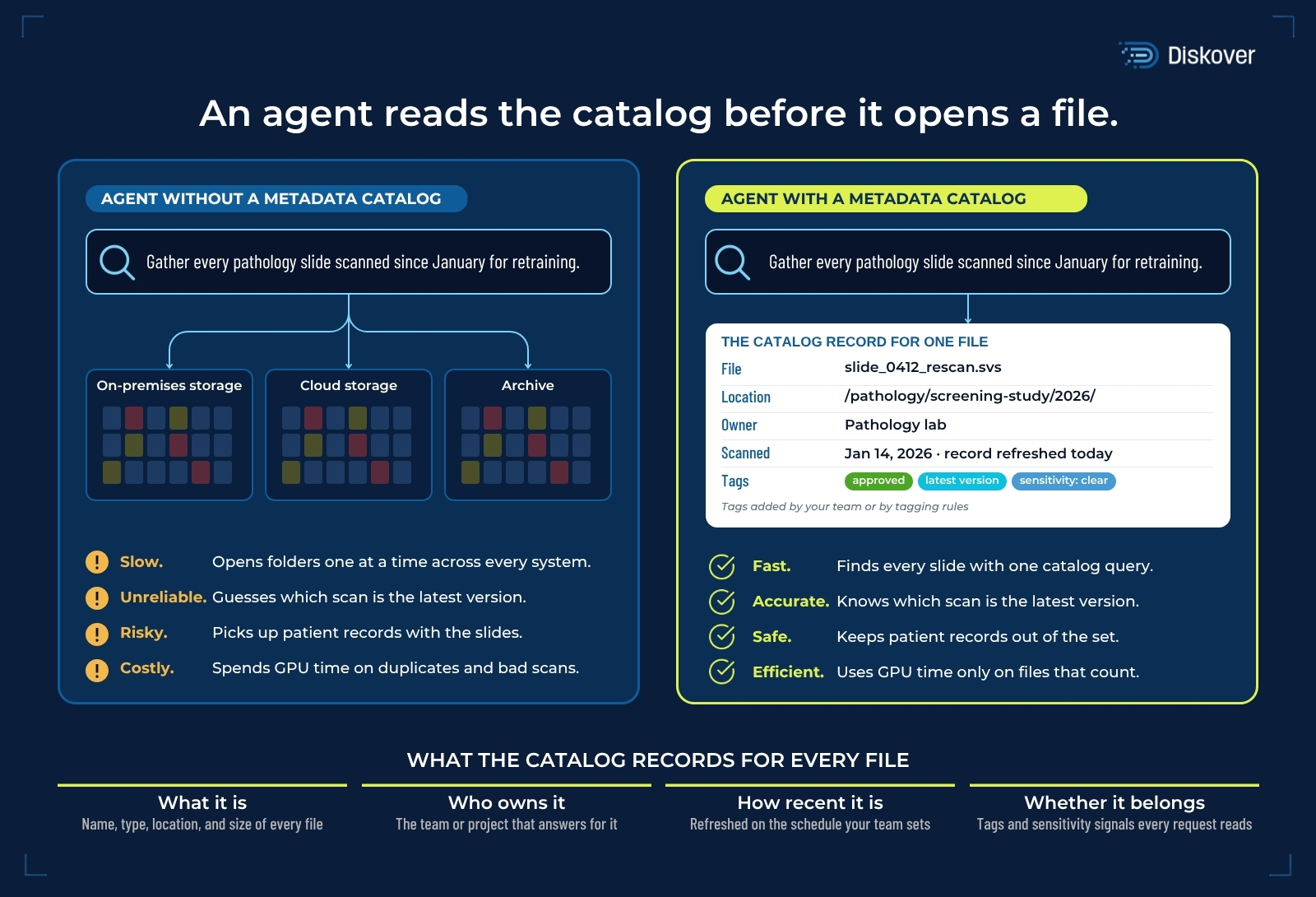
With a metadata catalog in place, the agent reads the records of all three folders first, without opening a single slide. One record carries the “approved” tag, the most recent dates, and the pathology lab as owner. The agent picks that folder and opens only the slides inside it.
The table compares AI-ready and agent-ready data on five points.
| QUESTION | AI-READY DATA | AGENT-READY DATA |
|---|---|---|
| Who picks the files? | A data scientist picks the slides and reviews the list once | The agent picks the slides each time a request arrives |
| What gets read first? | The files in the prepared set | The catalog record for every slide across your storage |
| How recent must the information be? | Accurate on the day the set was assembled | Accurate at the moment the agent asks |
| How do patient records stay out? | A reviewer removes them once, from one set | A sensitivity tag on each record keeps it out of every request |
| What happens at the end? | A prediction, and a person decides what comes next | An action, such as tagging or moving files, approved by a person first |
Agent-ready data starts with a metadata catalog.
An agent connected straight to your storage, with no catalog, has to open folders one by one to learn what exists.
Across billions of files, every question becomes a slow scan or a ticket to the storage team. It is like looking for one topic in a 500-page book by reading every page, because the index at the back is missing.
A metadata catalog is that index for your storage, and it holds more than file names. Rules, tags, and enrichment plugins add business context metadata, the context that lives outside the file system, such as the study, the scanner, the approval status, and the retention period. That context is what lets an agent tell an approved slide from a rejected one.
The agent asks the catalog, receives an exact list, and opens only the files the task needs.
Diskover builds that catalog across every storage vendor, tier, and location, so one query covers the whole estate.
That precision also protects your compute budget. Every file in a training set costs graphics processing unit (GPU) time. A duplicate slide counts twice, and a blurred rescan teaches the model from a bad image, yet both cost the same GPU hours as a good slide. A set selected from the catalog keeps only the files that improve the model, so each GPU hour goes into accuracy.
A metadata catalog gives an AI agent one place to learn what exists before it opens a file.
The catalog has to be up to date when the agent asks.
A training set is a snapshot: a copy of a chosen group of files as they were on the day someone assembled it. An agent works on live storage, so how old the catalog record is affects every answer the agent gives.
A navigation app that shows this morning’s traffic still gives directions. They are simply wrong for the road you are driving now.
Picture a slide rescanned this morning because the first image was blurred. If the catalog was last refreshed yesterday, the agent finds only the blurred scan and adds it to the training set. It followed its instructions and still used the wrong image.
How current a catalog is depends on how often it is refreshed, so a refresh schedule is part of being agent-ready. Indexing runs on a schedule your team sets, and Diskover has indexed 1.4 billion files in 2 hours. After that first full scan, cached scanning re-reads only the folders that changed since the last scan and takes the rest from a local cache, so refreshing every day, or every hour, stays practical even on very large estates.
How old was the catalog record behind the last file your agent used?
With a scheduled refresh, the answer is a known interval rather than a guess. Agent-ready data carries a known refresh interval, so every answer comes with an age.
Every file carries its own boundary.
In an AI-ready workflow, a reviewer removes restricted material once, from one set, for example, every scan whose file name contains a patient’s medical record number. An agent writes a new request every time, so the rule about what stays out has to be recorded on the files themselves, where every request can read it.
Hospitals solve the same problem with medication labels. The warning is printed on the bottle, so every nurse on every shift reads the same caution, whoever filled the order.
A sensitivity signal, a flag the catalog sets when a file’s name, path, or location points to private data, marks that file for a person to review. Diskover works from file attributes alone, without opening file contents, so the check stays fast, even across billions of files.
Your access controls decide which files an agent is allowed to reach. The catalog adds the other half: what each of those files is. With both in place, one rule can keep patient records out of every training set, for every agent your team deploys.
Which of the files your agent can reach belong outside the screening model’s training set?
The ones the catalog has already flagged. A sensitivity signal recorded once in the catalog lets every agent request exclude the same files.
A person approves before the agent acts.
A model trained on AI-ready data produces a prediction. An agent takes an action: it tags files, archives a project, or copies a set to the training cluster. McKinsey’s guidance on agentic AI calls for explicit policies covering what agents can do, what data they can reach, and when a person must approve.
A pharmacist checks every prescription before filling it. The doctor decides, the pharmacist confirms, and only then does the medicine leave the pharmacy.
In Diskover, your team can search the catalog and tag files directly in the interface. The Diskover AI Connector adds a second option: it links the AI assistant or agent platform your team already uses, such as ChatGPT, Claude, or Microsoft Copilot Studio, to the same metadata catalog. Either way, a person approves each action.
Who approved moving last year’s completed study folders to the archive tier last night?
A named person did, before any file moved. You ask the AI Connector a question in plain language, such as which study folders have sat untouched for a year, and get the matching files back with a recommended action attached. A person approves it, Diskover tags the matching files, and the workflows your team set up for those tags run next. AI-assisted, human-approved.
The AI Connector runs on the Model Context Protocol (MCP), the open standard that lets AI assistants query real systems. Diskover’s product team has written up how it built its MCP connector. The same access controls and audit trail as the Diskover interface apply to every AI request.
Describe your data estate first, then add agents.
When you make one dataset AI-ready, that work serves one model, and the next project starts again from zero. Agent-ready work stays with your data instead. The catalog, the refresh schedule, the sensitivity tags, and the approval step cover every file you store, rather than one project, so each new agent uses all four from its first request.
Picture the request that arrives next quarter: an agent for the finance team, asking which departments drive storage growth. It starts from the same catalog the research agent used.
Agent-ready data is work you complete once and every later agent builds on.
KEY TAKEAWAY
Know your files before your agents do.
- AI-ready data is a reviewed set chosen before a model runs. Agent-ready data is every file you store, described well enough for an agent to choose the right files on its own.
- An agent reads the catalog before it opens a file, so the catalog decides what the agent finds, uses, and leaves out.
- Set up the catalog, its refresh schedule, the sensitivity tags, and the approval step once, and every new agent can use them from its first request.
Before your agents act, know what they will touch.
Diskover indexes every file across every vendor, tier, and location into one metadata catalog that people, pipelines, and AI agents can query, with a person approving each recommended action.