


DATASHEET | DATADELIVERY
DataDelivery: data in motion, intelligence in action, global control.
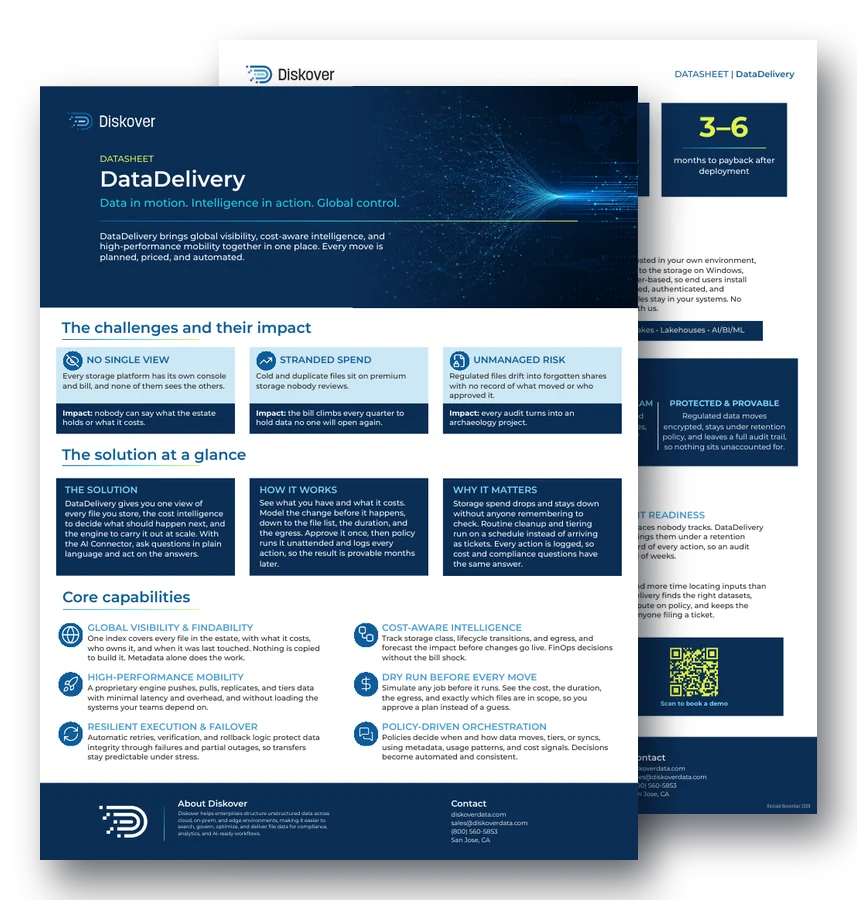
DataDelivery brings global visibility, cost-aware intelligence, and high-performance data mobility together in one place. Every move is planned, priced, and automated.
30-50%
of storage reclaimed by tiering and removing ROT data
50 Gbps
transfer speed with a single agent
30+
hours a week returned to data teams
3-6
months to payback after deployment
At a glance.
The challenge.
Every storage platform has its own console and bill, and none of them sees the others. Cold and duplicate files sit on premium storage nobody reviews, and regulated files drift into forgotten shares with no record of what moved.
The solution.
DataDelivery gives you one view of every file you store, the cost intelligence to decide what should happen next, and the engine to carry it out at scale. Model the change first, down to the file list, the duration, and the egress, then approve it once.
Why it matters.
Storage spend drops and stays down. Routine cleanup and tiering run on a schedule instead of arriving as tickets, and every action is logged, so cost and compliance questions have the same answer.
Core capabilities.
Global visibility and findability.
One index covers every file in the estate, with what it costs, who owns it, and when it was last touched. Nothing is copied to build it. Metadata alone does the work.
Cost-aware intelligence.
Track storage class, lifecycle transitions, and egress, and forecast the impact before changes go live. FinOps decisions without the bill shock.
High-performance mobility.
A proprietary engine pushes, pulls, replicates, and tiers data with minimal latency and overhead, at up to 50 Gbps with a single agent, without loading the systems your teams depend on.
Dry run before every move.
Simulate any job before it runs. See the cost, the duration, the egress, and exactly which files are in scope, so you approve a plan instead of a guess.
Resilient execution.
Automatic retries and checksum verification protect data integrity through failures and partial outages, so transfers stay predictable under stress.
Policy-driven orchestration.
Policies decide when and how data moves, tiers, or syncs, using metadata, usage patterns, and cost signals. See policy-based data management.
How it works.
1. See
STORAGE OR IT TEAM
See what you have and what it costs, across every platform, in one index.
Example: every tier shows its size, owner, and monthly cost.
2. Model
ANY AUTHORIZED TEAM
Model the change before it happens, down to the file list, the duration, and the egress.
Example: a planner sees what a tiering policy would save.
3. Approve
ANY AUTHORIZED TEAM
Approve the plan once. Nothing moves until a person says yes.
Example: a storage lead approves next month’s cold-data move.
4. Run
BY POLICY
Policy runs the job unattended and logs every action, so the result is provable months later.
Result: routine tiering runs on a schedule, not as tickets.
Built for modern enterprise data environments.
Fast and open
Dynamic threading, multipart acceleration, and bandwidth control keep large transfers fast. Standard APIs, webhooks, and role-based access control mean no lock-in.
Secure and yours
A controller runs as SaaS or in your own environment, with lightweight agents on Windows, Linux, or Mac. No copy of your data ever lives with us.
Encrypted transfers
Transfers are encrypted, authenticated, and checksum verified, and your files stay in your systems.
No install for users
Access is browser-based, so end users install nothing.
Outcomes teams can measure.
Savings that hold.
Tier down what nobody opens, defer the next capacity purchase, and let policy keep your storage lean and clean.
Decisions you can defend.
Model any change before it happens, so cost and consequence are known at approval, not after the fact.
Hours back to your team.
Plain-language answers and policies replace ticket queues, spreadsheets, and one-off scripts.
Protected and provable.
Regulated data moves encrypted, stays under retention policy, and leaves a full audit trail.
Questions people ask.
What is DataDelivery?
DataDelivery is the part of the Diskover platform that plans, prices, and carries out data movement at scale: tiering, migration, replication, and sync, run by policy with a full audit trail.
How fast can DataDelivery move data?
A single DataDelivery agent transfers data at up to 50 Gbps, and several agents can share one job.
Can I see the cost of a move before it runs?
Yes. A dry run shows the cost, the duration, the egress, and exactly which files are in scope, so you approve a plan with the numbers known.
Does Diskover keep a copy of my data?
No. Transfers run between your own systems, encrypted and checksum verified, and no copy of your data ever lives with Diskover.
How does DataDelivery help a storage refresh?
It inventories the estate, models the job with its cost and duration, and carries only what matters onto the new platform, so years of unused files stay behind.
Related resources.
See it on your own data.
We’ll index a sample of your environment and show you
what’s recoverable against your current storage spend.