

BLOG
AI recordkeeping for financial firms starts with the files.
November 4, 2026 · ~7 min read
Pick a client communication your firm drafted last spring with help from an artificial intelligence (AI) tool.
Now show how it was produced: which data the model drew on, which version of the model ran, what the prompt said, and who approved the result before it went out.
AI recordkeeping is the practice of keeping those records together, so a firm can rebuild an AI-assisted decision months after it was made.
Most of that evidence sits in files on shares and in cloud buckets, spread across the teams that built, tested, and used the tool. And when the request comes, you are the person who has to assemble it.
The rules already cover the work AI does.
The obligation is older than the tools. In Regulatory Notice 24-09, published June 27, 2024, the Financial Industry Regulatory Authority (FINRA) reminded firms that its rules, which are intended to be technology neutral, continue to apply when firms use generative AI.
The FINRA 2026 Annual Regulatory Oversight Report goes further. It says generative AI use “can implicate rules regarding supervision, communications, recordkeeping and fair dealing,” and the practices it describes include storing prompt and output logs and tracking which model version was used and when.
The retention clock is familiar too. Under Securities and Exchange Commission (SEC) Rule 17a-4, broker-dealers keep many records for three or six years, with the first two in an easily accessible place.
The SEC enforces it: the SEC announced on January 13, 2025, that 12 firms paid a combined $63.1 million for failing to keep and preserve electronic communications.
What AI changes is where the records sit.
- A trade confirmation lands in a books-and-records system built for it.
- The evidence behind an AI-assisted output lands wherever the data science team saved its work.
Your compliance and legal teams decide which records each rule requires. AI recordkeeping adds a second job to that one: finding the files.
What an AI-assisted decision leaves behind.
Take a wealth management team that uses a model to draft quarterly portfolio review letters. One letter, sent to one client, leaves this trail:
| EVIDENCE | WHERE IT LANDS | WHAT IT PROVES |
|---|---|---|
| The data extract the model drew on | A data science share or a cloud bucket | Which client and market data shaped the letter |
| The dataset snapshot | A versioned folder, renamed at the next release | That the data matched what was approved at the time |
| The model version and its configuration | A folder of configuration files or a registry export | Which model ran, and when |
| Validation and test results | A notebook output folder | That someone checked the model before it went live |
| Prompt and output logs | An application log directory | What was asked and what came back |
| The approval | An email, a ticket, or a signed document | Who reviewed the letter before release |
Six kinds of evidence, four or more storage locations, and three teams that each kept their part for their own reasons. Every file was saved by someone doing their job well. The gap is that the set was never described as one set, so a request for it becomes a search across systems that were organized for other purposes.
Which folder held the extract the model used last March? The answer sits in the file’s metadata, such as its path, its owner, its dates, and its name. Those facts exist for every file the moment it is written, and they are the thread that ties the six pieces together.
Why the trail breaks before anyone asks for it.
Evidence rarely disappears in one event. It erodes through routine work:
- The next model release overwrites the snapshot folder.
- A project share gets reorganized and every path changes.
- The data scientist who ran the validation leaves, and the home directory gets archived.
- A storage cleanup policy deletes log files older than 90 days, because to a storage system, a folder of logs looks like temporary output.
That last case is the one to watch. A prompt log looks like clutter to a cleanup policy and like a record to an examiner. The same file changes value depending on what it documents, and only its description tells the two apart.
The cost shows up in units your firm already tracks. A request for one AI-assisted letter becomes a week of tickets to information technology (IT), three teams pulled off project work, and a response partly rebuilt from memory.
Thales reports in its 2026 Data Threat Report that only 34% of organizations know where all their data is. For a firm that has to answer an examiner, that figure describes the starting point of every request.
AI recordkeeping starts with a catalog of file metadata.
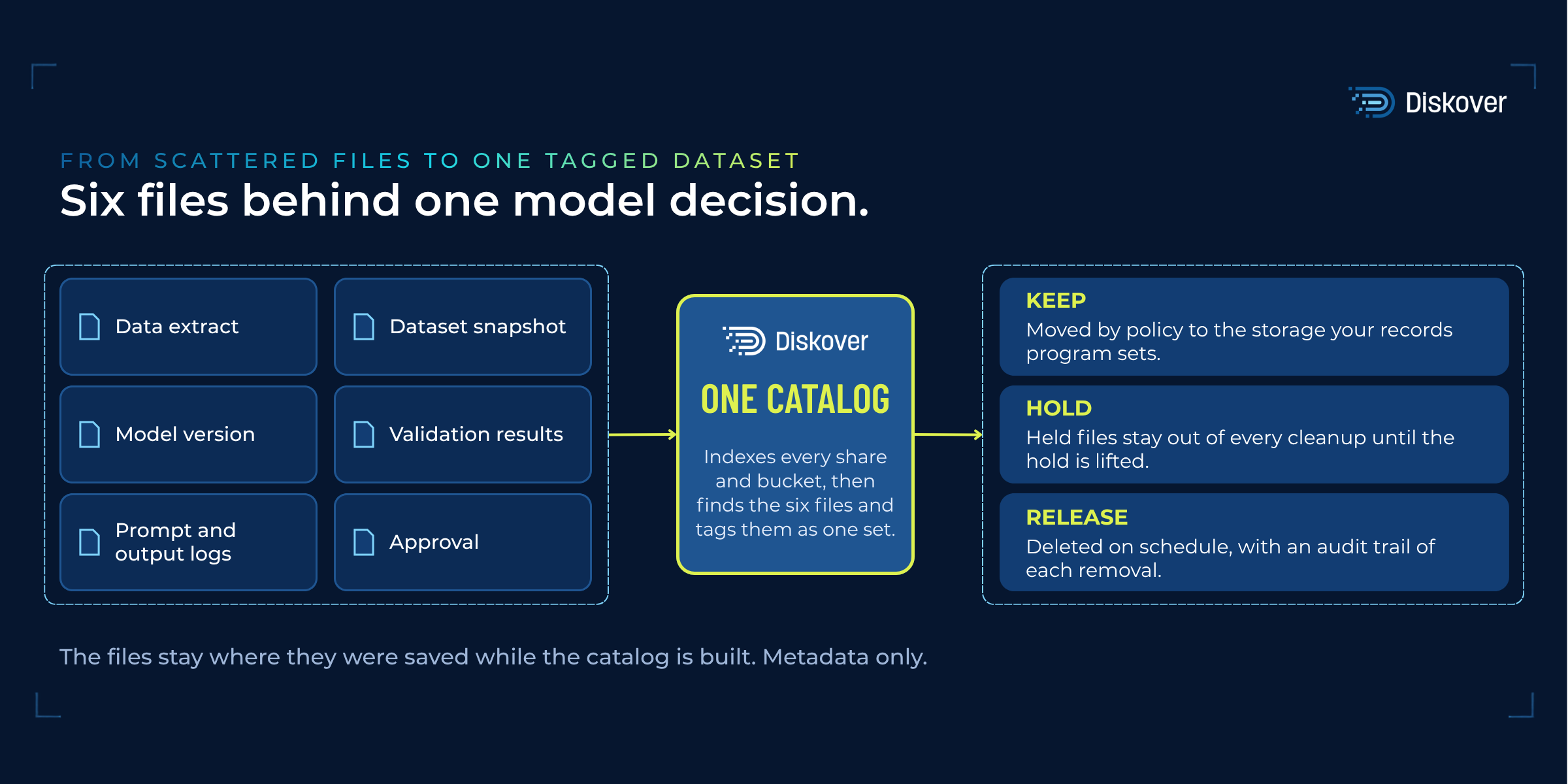
A metadata catalog is an index of every file’s name, path, size, owner, and dates, built across every share and bucket. Diskover builds that catalog from metadata while the data stays in place, and it moves files only when a workflow calls for it.
The index holds file descriptions, so the client data inside the files stays inside the files. That makes the catalog a fast and non-invasive way to describe a data estate at scale.
With the catalog in place, the March question becomes a search: every file under the portfolio model’s project paths, modified between February and April, owned by the data science team, with the extensions the pipeline writes.
Enrichment adds what the file system lacks. A tagging rule can find every file under the portfolio model’s project folder and tag it with the model name, the release, and the retention class. A small text file placed in a project folder can also add fields, such as the owner and the project, to that folder’s record.
A compliance analyst can also ask the catalog in plain language through the AI Connector, for example, “which files belong to the March release of the portfolio letter model,” and get the matching files back with a recommended tag. The tag applies only after a person approves it: AI-assisted, human-approved. It is the same standard examiners ask firms to apply to their own AI tools.
Keep what the rules require. Release the rest on schedule.
Finding the evidence is half the work. The other half is keeping it for the right period, and only for that period.
Once the files carry a retention tag, a policy copies or moves them to the storage your records program designates, and the decision follows the tag rather than a person’s memory of what mattered. Files under a legal hold carry a hold tag, and cleanup policies leave them out until the hold is lifted.
At the end of the period, the same tags drive defensible deletion: removing files on a documented schedule, with an audit trail that shows what was deleted, when, and under which policy.
A prompt log from a pilot that never reached a client holds a different value than the log behind a client letter, and the catalog lets each one follow its own schedule. The questions behind that schedule sit on the data governance, retention, and risk page of our glossary.
Records management software used by large banks already relies on Diskover’s scanner to bring file metadata into its pipelines for holds, disposal, and classification. Diskover supports that work as the catalog under the records program, and the records program keeps the authority over what counts as a record.
Run the 12-month test this quarter.
Brian Rubin of Eversheds Sutherland suggested a simple check at a July 2026 webinar, as reported by FinTech Global: take a decision from six or 12 months ago and try to rebuild how it was reached.
Run it on one AI-assisted output your firm produced 12 months ago. Time how long it takes to produce five things: the data it drew on, the model version, the prompt and the output, the validation result, and the approval.
Count the teams you asked and the tickets you opened. That number measures your AI recordkeeping in the unit an examiner cares about, which is days.
How many days would your answer take today?
The fix starts with the files being written this week. Agree on the paths and naming your AI projects use, index those locations, and tag the evidence while the people who made it still remember what it is.
The same test applies to an insurer’s claims model and a bank’s credit model, because both leave the same kind of trail. The financial services data management page shows how one catalog serves banks, asset managers, and insurers.
Next year’s exam evidence is being written to disk this week. Describe it while the people who made it are still here.
KEY TAKEAWAY
Describe the evidence while it is fresh.
- The records behind an AI-assisted decision are ordinary files, saved by different teams for their own purposes.
- One catalog can describe them all in one view while they stay where they were saved.
- Find them by their metadata, tag them while the people who made them still know what they are, and let the tags decide what is kept, held, and released.
Find every file behind an AI decision.
See how Diskover finds, tags, and keeps the files behind your firm’s AI-assisted work, from metadata alone.