


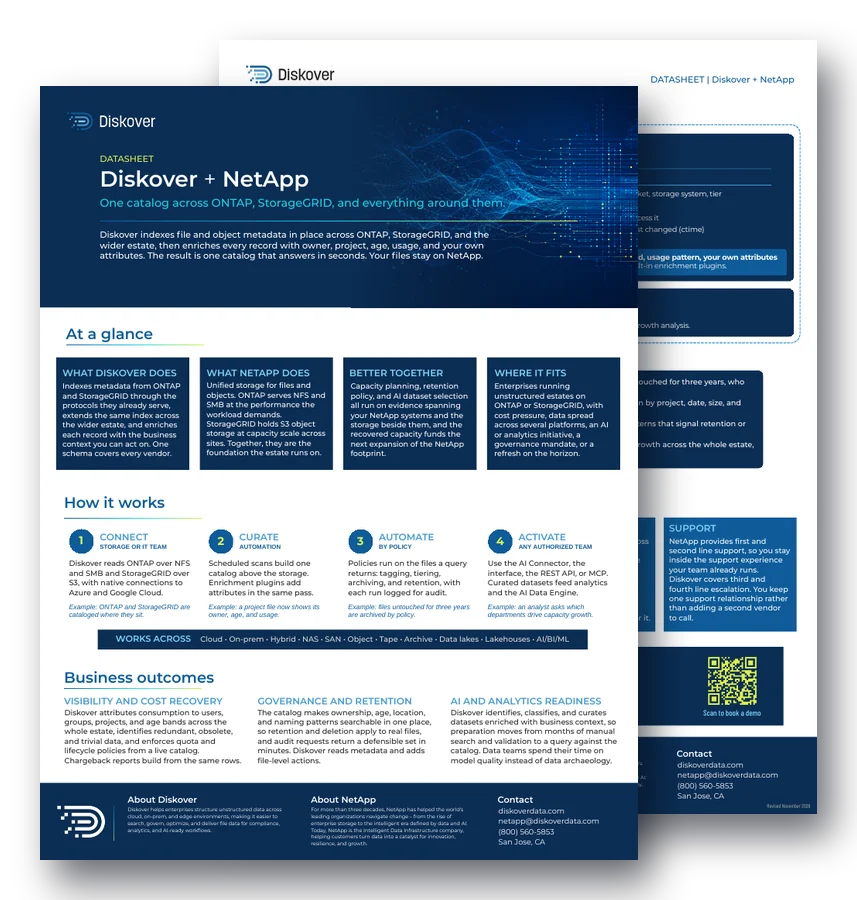
DATASHEET | DISKOVER + NETAPP
One catalog across ONTAP, StorageGRID, and everything around them.
Diskover indexes file and object metadata in place across ONTAP, StorageGRID, and the wider estate, then enriches every record with owner, project, age, usage, and your own attributes. Your files stay on NetApp.
30-50%
of storage reclaimed by tiering and removing ROT data
1.4B
files indexed in 2 hours, about 200K files per second on 3 nodes
29
built-in metadata enrichment plugins
3-6
months to payback after deployment
At a glance.
What Diskover does.
Indexes metadata from ONTAP and StorageGRID through the protocols they already serve, extends the same index across the wider estate, and enriches each record with business context. One schema covers every vendor.
What NetApp does.
Unified storage for files and objects. ONTAP serves NFS and SMB at the performance the workload demands, and StorageGRID holds S3 object storage at capacity scale across sites.
Better together.
Capacity planning, retention policy, and AI dataset selection all run on evidence spanning your NetApp systems and the storage beside them, and the recovered capacity funds the next expansion of the NetApp footprint.
What you get.
What the catalog holds.
One row per file or object, with identity (name, path, volume or bucket, system, tier), size and type, owner and group, time fields such as last modified and last accessed, and enrichment fields such as project, department, age band, and your own attributes. Capacity records add one row per volume or bucket over time.
Ask in plain language.
Ask through the AI Connector, or filter in the interface. Answers come from metadata, so they return in seconds, and each one carries a recommended action your team approves before it runs.
Visibility and cost recovery.
Diskover attributes consumption to users, groups, projects, and age bands across the whole estate, identifies redundant, obsolete, and trivial data, and builds chargeback reports from the same rows.
Governance and retention.
Ownership, age, location, and naming patterns are searchable in one place, so retention and deletion apply to real files and audit requests return a defensible set in minutes.
AI and analytics readiness.
Diskover identifies, classifies, and curates datasets enriched with business context, so preparation moves from months of manual search to a query against the catalog. Curated datasets feed analytics and the NetApp AI Data Engine.
One support relationship.
NetApp provides first and second line support, so you stay inside the support experience your team already runs. Diskover covers third and fourth line escalation.
How it works.
1. Connect
STORAGE OR IT TEAM
Diskover reads ONTAP over NFS and SMB and StorageGRID over S3, with native connections to Azure and Google Cloud.
Example: ONTAP and StorageGRID are cataloged where they sit.
2. Curate
AUTOMATION
Scheduled scans build one catalog above the storage. Enrichment plugins add attributes in the same pass.
Example: a project file now shows its owner, age, and usage.
3. Automate
BY POLICY
Policies run on the files a query returns: tagging, tiering, archiving, and retention, with each run logged for audit.
Example: files untouched for three years are archived by policy.
4. Activate
ANY AUTHORIZED TEAM
Use the AI Connector, the interface, the REST API, or MCP. Curated datasets feed analytics and the AI Data Engine.
Example: an analyst asks which departments drive capacity growth.
Deployment and data handling.
Deployment
Runs entirely inside your environment, on-prem or in your virtual private cloud, with task workers placed close to the storage each one indexes.
Onboarding
Guided onboarding covers package delivery, setup, volume discovery, and dashboards. Adding a volume later takes a connection and a scan.
Data handling
Diskover reads metadata across every connected system. File content stays on your storage throughout scanning, enrichment, and querying.
Questions the catalog answers.
Untouched data.
Which volumes and buckets hold data untouched for three years, who owns it, and what reclaiming it returns.
Training-ready files.
Which files already qualify for a training run by project, date, size, and format, and how big that dataset is.
Capacity growth.
Which departments are driving capacity growth across the whole estate, quarter over quarter, and by how much.
Questions people ask.
How does Diskover connect to NetApp storage?
Diskover reads ONTAP over NFS and SMB and StorageGRID over S3, the protocols they already serve, and extends the same index to the wider estate.
Do my files leave NetApp?
No. Diskover reads metadata only. File content stays on your NetApp storage throughout scanning, enrichment, and querying.
Who supports Diskover for NetApp customers?
NetApp provides first and second line support, and Diskover covers third and fourth line escalation, so you keep one support relationship.
Can the catalog feed the NetApp AI Data Engine?
Yes. Diskover curates datasets enriched with business context, and curated datasets feed analytics and the AI Data Engine.
How often does Diskover update the catalog?
Diskover indexes storage by volume, and you decide the indexing schedule for each one, based on its size and on how often its files change. Active project volumes are often re-indexed every 10 to 30 minutes, while backup and archive volumes are usually re-indexed once a week or once a month. Rescans are faster than the first index, about 500,000 to 600,000 files per second, because Diskover skips folders that have not changed.
Related resources.
See it on your own data.
We’ll index a sample of your environment and show you
what’s recoverable against your current storage spend.