

BLOG
In post, the AI worth having never touches the creative.
August 20, 2026 · 6 min read
Two in the morning, and the version is missing.
An online editor is 30 minutes from a conform and one shot short. The visual effects (VFX) vendor delivered version 6 four days ago. What sits on the nearline is version 4. Somebody has version 6 on a workstation, in a shared bucket, or on the drive that went home with the assistant editor. 90 minutes later, the show is back on track, and in all that time, nobody created anything.
That night is the real bottleneck in post-production, and it repeats across every facility in the business. The work was locating one file and moving it to where the timeline could see it.
How many of those hours did your facility lose last quarter?
This is where artificial intelligence (AI) earns its place in post: in the estate, underneath the timeline, where nobody wants to spend time searching from memory.
Your media lives everywhere the work happened.
Post is a file-based business that runs on locations nobody wrote down. Camera originals land on ingest storage. Dailies and proxies multiply across editorial. Graphics and VFX pulls travel out to vendors and come back as new versions. Conform masters go to tape, deliverables go to clients, and the archive quietly accumulates on linear tape-open (LTO) cartridges in a room where the labels stopped matching the contents around 2019.
Your media asset manager (MAM) catalogs what you ingested into it, and it does that job well. The estate holds more than that: the render written straight to a project share, the client version somebody uploaded from a hotel, the graded master that only exists on tape. Ask three people where a finished show’s elements live, and you will get three partial answers, all of them true.
Your library is what somebody cataloged. Your estate is what you actually have. The distance between the two is where the hours disappear.
None of that is anyone’s fault. It is what happens when a business ships on deadline for 20 years. Every rush job leaves a copy somewhere sensible at the time, and enough of those sensible decisions eventually make an estate unsearchable. The facility that has been running longest usually has the worst visibility, because it has the most history.
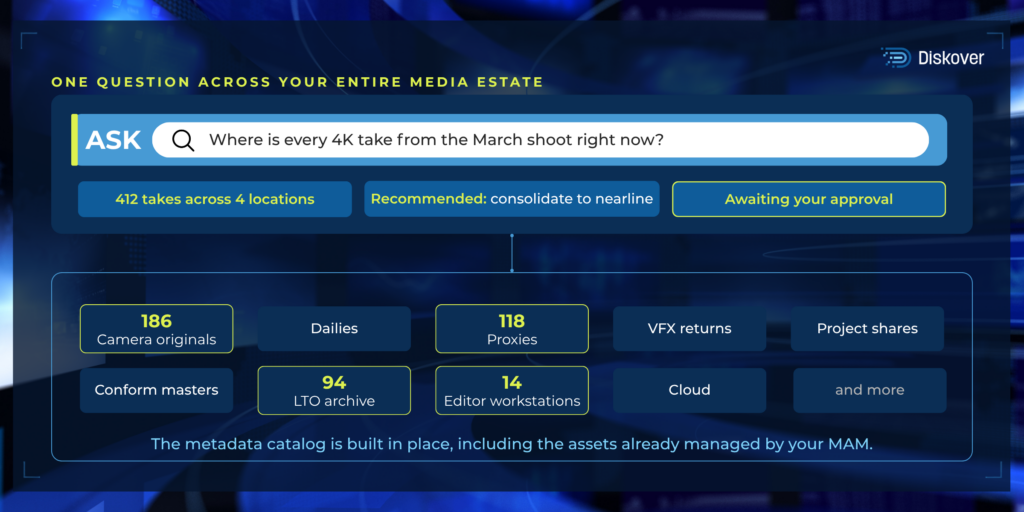
Ask yourself the plainest possible question: where is every 4K take from the March shoot right now, across the entire estate?
A complete answer requires a single index that spans every tier, built from metadata alone. Diskover sits above the storage layer and indexes every file across every vendor, tier, and location without moving or copying a single frame. The catalog is built in place, leaving the data exactly where it is. What you get back is one searchable view of your entire data estate, including the parts that were never ingested anywhere.
An index only helps if it reflects the estate as it is now, rather than as it was last week. Scans run on a cadence you set, and a busy repository can refresh as often as every 10 minutes, so the answer you get at two in the morning includes the version that landed at midnight.
Ask the estate in plain language.
Once the index exists, the questions your team has been answering by walking the floor become questions you can type. Which takes from the March shoot are not in the current project? Which masters have no tape copy? Which proxies belong to a show that was delivered 18 months ago? Which files carry a talent agreement that has not expired?
The answer comes back with a recommended action attached, and your team decides whether to run it. AI-assisted, human-approved is the operating principle: the system surfaces the relevant files and proposes the action, while a person who knows the show makes the final call. That combination makes this kind of AI practical and safe to use in a working facility.
Time is the return. Research from the London School of Economics and Protiviti found that professionals using AI save an average of 7.5 hours a week, close to a full working day. In post, those hours are currently going into searching, chasing versions, and waiting for restores. What would your assistant editors do with a day a week back?
Move only what the shot needs.
Finding the media is half the job. The other half is getting the right media to the right person, at the right size, so they can get to work without moving more data than the job requires.
A colorist working remotely needs the graded master, not the entire show folder. A trailer house needs 11 selects, not the full season. A VFX vendor needs the plates for one sequence and the reference for another. When the available workflow means copying the entire directory, transfers take longer, cost more, and create duplicate data that adds to storage costs over time.
Because every file is indexed with its metadata, a request becomes a precise set: these versions, at this resolution, to this destination. Cost and duration are calculated before the transfer begins, turning delivery into an informed decision. Data moves when a workflow calls for it, in the form and scope the work requires.
The duplicates are where the cost compounds. A show that delivers cleanly can still leave four copies of the same sequence behind: the vendor’s return, the version editorial pulled, the copy sent to the client, and the one somebody staged for archive but never completed. Multiply that across every show a facility ran last year, and a meaningful share of your premium storage tier may be holding the same frames several times over.
That raises a useful question before the next capacity conversation: How many copies of last season’s masters are you currently paying to keep online, and can you see that count today?
The archive that could be earning.
Every facility and rights holder is sitting on decades of material that still holds value: anniversary cuts, documentary licensing, sponsor reels, retrospectives, and the sudden need for a specific play from a specific season. Rights are rarely the obstacle. The challenge is finding the right material quickly enough for the opportunity to matter.
One searchable catalog across the archive changes the economics. An NFL franchise brought 60 years of game footage online this way, made the entire archive searchable, and now delivers remote game-day footage to coaches in real time. The archive stopped being a storage line item and became something the business could sell from.
What would your team do with a request for footage from 1994 if the answer took an afternoon instead of a month?
What the AI never decides.
The suspicion in this industry is reasonable, and it extends beyond creative jobs. A 2026 Thales report, based on a survey by S&P Global 451 Research, found that 61% of organizations now cite AI as their top data-security risk. Anyone who has watched a well-meaning automation delete the wrong folder has earned the right to be careful.
That makes the boundary more important than the capability. AI can recommend; people decide. Every proposed action comes with the evidence behind it: what the files are, where they live, what they cost, and what will happen when they move. A person approves the action, and that approval stays with the record, so the next person can see who made the call and why.
That same principle makes retention manageable. Masters remain under policy. Talent agreements and regulated records stay where the rules require. Material that reaches the end of its retention period follows the policy you defined, on the schedule you set, with the decisions documented along the way.
Creative decisions stay with the people who make them for a living. The searching, tracking, and moving become infrastructure they can rely on.
KEY TAKEAWAY
Machines find, people decide.
Post-production does not need artificial intelligence in the timeline. It needs the file the timeline is waiting for, on the storage the artist can reach, before the window closes.
Give the estate a memory, and the searching stops being a craft skill. What your team is paid for is judgment, and judgment is the one thing you should never automate.
Give the night back to your artists.
See how much of your estate is unaccounted for, and what one searchable view would change about next week’s delivery.