

BLOG
The storage you’re paying for but no longer need.
August 26, 2026 · 5 min read
Every year, your storage footprint grows, and the invoice grows with it.
Here is the important question: How much of the data you’re paying to keep still serves a purpose? Over time, storage accumulates redundant, obsolete, and trivial data. Files that remain on expensive tiers long after their active use has ended.
Before you approve the next capacity purchase, look at the data you already have. How much could your team confirm is still needed? For many enterprises, that answer is difficult to see. That visibility gap is where redundant, obsolete, and trivial (ROT) data builds up.
Redundant, obsolete, and trivial: the data you forgot you had.
Redundant is the fifth copy of the same file scattered across four teams. Obsolete is the project that closed three years ago and still occupies active storage. Trivial is the collection of temporary files, exports, and working copies that accumulate across shares, laptops, and buckets.
In a post-production facility, it can be last season’s dailies, intermediate renders, review reports, and other working files that have served their purpose but remain in premium storage.
In a research lab, it can be instrument output from a study that closed two budget cycles ago.
One stale file is easy to overlook. Across billions of files, those small amounts accumulate into a permanent line on the budget. Independent research puts the share of enterprise data that is unused or unwanted at 41%. That represents storage capacity that can be recovered and put to work elsewhere.
Why it piles up.
ROT is arithmetic, not indiscipline. Data is created constantly, while deletion requires context: who owns this file, is anyone still using it, and does a regulation require you to keep it? Multiply those questions across billions of files spread across network-attached storage (NAS), cloud, and archive, and cleanup becomes a visibility problem rather than a housekeeping task.
Picture how the question usually arrives. Finance asks which projects are driving next year’s capacity needs. The question becomes a ticket to storage operations, then a week of spreadsheet archaeology, followed by a number nobody fully trusts. How many of those weeks did your team spend last quarter?
So the estate grows quietly, often on the tier you provisioned for performance. When you cannot see what you already hold, the obvious response to “we are running out of room” is to add more capacity. With better visibility, you can identify what still serves the business, what can move to a more appropriate tier, and what has reached the end of its useful life. That turns capacity planning from a guess into a decision grounded in the data you already have.
The cost that never reaches the invoice.
Wasted spend is the ROT cost you can measure. The harder cost to quantify is risk. Every forgotten file can become part of your attack surface, and as the volume grows, so does the potential impact of a security incident. A breach can reach far beyond the data you actively monitor, including years of files that have faded from view.
Governance carries the same weight. Sensitive data, including personal records, contracts, and regulated information, does not stay where you filed it. Copies drift into project folders, shared drives, and archives. Industry research puts the share of stored data whose value is simply unknown at 52%.
When your auditor asks what personal data you hold and where it lives, ROT is the part of the estate you cannot answer for, and the clock on that answer runs in days, not weeks.
You can’t delete what you can’t see.
Here is why the problem survives even when everyone agrees it is a problem. You cannot safely delete what you cannot identify. Remove the wrong file, one under legal hold or one a live pipeline still depends on, and you have traded a storage bill for a far worse day. So the safe-looking choice is to keep everything, and the estate deepens.
Ask a storage lead to clear a few hundred terabytes of last year’s renders, and the reply is a question of its own: who signs that off? Nobody wants to be the person who deleted the master a colorist asks for six months later, or the sequencing output a paper turns out to depend on. Without evidence, the cautious answer is always no, and the cautious answer is what you are paying for.
Defensible deletion needs two things at once: a complete view of what you have, and a record of why each decision was made. Without the first, nobody will approve a cleanup at scale. Without the second, nobody can answer for it months later when the question comes back. Your team wants ROT gone. What they lack is the proof that makes removing it safe.
See it first, then act.
The way out is to make the data visible before you touch it. Index the metadata across every system into one searchable catalog, and the questions that were unanswerable become ones you can simply ask.
Ask which instrument runs have not been opened in two years, where the duplicate renders live, which files are likely to hold regulated records, and what each of them costs to keep. The answer comes back in seconds with a recommended action attached. Artificial intelligence (AI) surfaces the files and recommends the action. You approve what happens next. AI-assisted, human-approved is the exact standard defensible deletion demands.
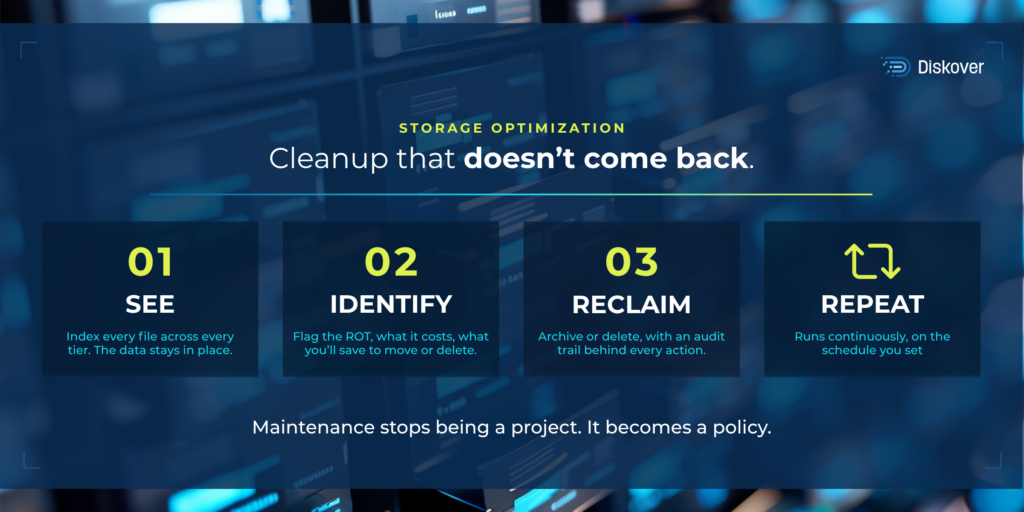
Diskover sits above the storage layer and indexes every file across every vendor, tier, and location without moving or copying a file. From that single view, cleanup stops being a project and becomes a policy. Flag the ROT, preview exactly what would be reclaimed, then archive or remove it with an audit trail behind every action. Nothing leaves the storage you chose, and every decision arrives with the record that makes it defensible.
The economics follow from the design. The capacity you free is capacity you already bought, so clearing ROT recovers an asset you have been paying to ignore.
A cleanup that doesn’t come back.
A one-time purge feels good and then quietly undoes itself. New projects spin up new duplicates, cold data ages in, and within a year the estate looks the way it did before. The only way to hold the savings is to let policy do the ongoing work. Define the rules once, archive what has not been touched in two years, flag anything that looks sensitive, and let them run on the schedule you set across every tier.
Your storage stays lean because maintenance is built into how the system runs. Reclaiming ROT once is a win. Keeping it gone is the strategy.
KEY TAKEAWAY
Know before you delete.
The largest line in your storage budget is capacity doing no work. You pay premium rates to keep it, you carry its risk, and you get nothing back. Visibility is what changes that, because once you can see what you hold, deletion becomes defensible instead of dangerous.
That turns ROT from a standing cost into the easiest capacity you will recover all year.
Stop paying to store data no one uses.
See how much of your estate is redundant, obsolete, or trivial, and what clearing it would give back.