

BLOG
AI does not stall on infrastructure.
It stalls on data.
Tony Chidiac, CRO, Diskover
August 19, 2026 · 8 min read

Tony Chidiac spent four years selling the foundation that enterprise artificial intelligence (AI) runs on. He joined NetApp in 2022 and rose to Head of Worldwide AI Sales, working inside the NetApp and NVIDIA ecosystem through the period when the storage conversation was rebuilt around AI. He saw the buying cycle from the inside, at the moment it was moving fastest.
He also kept posting something that sat slightly at an angle to his day job: that AI runs on data, and the real gain comes from a data management strategy rather than from the platform underneath it. In February 2026, he became chief revenue officer at Diskover, where data management is the product.
We asked him what he saw that moved him, and what separates the companies now getting real results.
The pattern he could not stop noticing.
The turning point was not a product or a competitor. It was a repeated outcome.
“The turning point came from watching hundreds of customers invest heavily in AI infrastructure while still struggling to generate meaningful outcomes. Graphics processing units, high-performance storage, and networking are all essential, but they don’t solve the underlying problem: organizations don’t understand the data they’re feeding into AI.”
— Tony Chidiac, Chief Revenue Officer, Diskover
That sentence describes a specific kind of meeting. The cluster is provisioned, the storage is fast, the team has a model selected, and the project is waiting on someone to assemble a dataset that nobody can locate in full. An engineering lead needs every simulation output from a test campaign that ran across three storage platforms and two sites. The request becomes a ticket to information technology (IT). Days later it comes back partial, because the person filling it had to guess which directories counted.
How many of your AI projects are currently waiting on a dataset rather than on compute?
Chidiac’s read is that the infrastructure argument was answered and the data argument never was. Across Core Scientific, where he ran sales through the company’s 2022 initial public offering, then NetApp, then Diskover, he describes the same job in three positions: enabling the next generation of computing. Compute first, then enterprise AI storage, now the data itself.
“Every major AI initiative eventually hits the same obstacle: finding, understanding, governing, and preparing enterprise data. Data management has become the control plane for enterprise AI.”
Not all data is created equal.
Storage answers whether data is available, protected, and fast. Chidiac’s point is that a different set of questions decides whether AI works, and those questions are about meaning rather than performance.
“What data do I have? Who owns it? Is it valuable? Is it sensitive? Should it be archived, deleted, or used for AI?”
Most enterprises cannot answer any of the five. Decades of accumulated files sit across network-attached storage (NAS), object storage, cloud buckets, and archives, and a significant share of it is redundant, obsolete, and trivial (ROT) data. The barrier is not willingness to clean it up.
“The challenge is that very few organizations have visibility into what they actually own.”
That is what a searchable catalog of the whole data estate changes. Index the metadata across every vendor, tier, and location, enrich it with business context like owner, project, age, and usage, and the unanswerable questions become ones a person can type. Nothing moves to build the catalog.
Chidiac is direct about what this is for. Clearing ROT lowers what you store. Enriching what remains is what lets it move: once a set is tagged and understood, Diskover streams it on policy into the analytics and AI platforms your teams already run, so a pipeline starts from a defined dataset rather than a directory somebody guessed at.
“In some environments, that means identifying and eliminating duplicates, obsolete, or low-value data. In others, it’s about surfacing the highest-value data to accelerate AI initiatives and empower engineering teams. For most enterprises, the real value comes from doing both simultaneously.”
The instinct is to buy more capacity.
The cost argument arrived on its own schedule. Between the second quarter of 2025 and the first quarter of 2026, pricing on 30 TB enterprise solid-state drives (SSDs) rose 257% according to storage vendor VDURA, taking a single drive from $3,062 to nearly $11,000. Hard disk pricing rose 35% over the same period.
“Buying more storage has historically been the easiest answer because storage prices generally declined over time. Today’s economics are different.”
The habit is rational until the price curve turns. When capacity got less expensive every year, buying ahead was the efficient decision, and auditing what you already held wasn’t worth the effort. Both halves of that calculation have now inverted, and the first move he recommends is not a purchase.
Eliminate redundant copies. Archive inactive content. Understand utilization. Then decide whether you need the capacity at all.
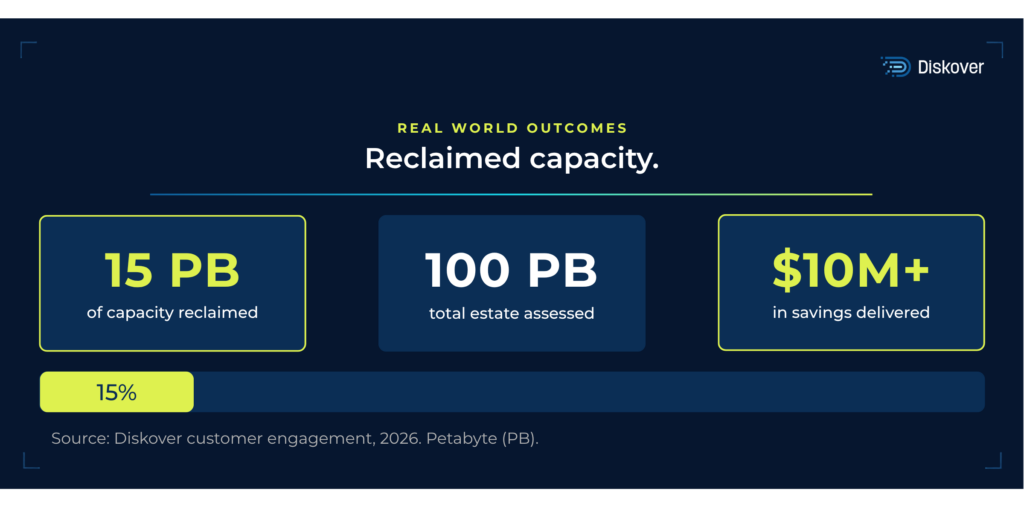
“Many customers discover they can delay significant capital purchases simply by managing data more intelligently. A manufacturing customer who went on this journey with us earlier in the year reclaimed 15 PB of capacity across a 100 PB estate. The result was over $10M in savings.”
Before your next capacity conversation, could anyone in your organization say what share of the current estate is still needed?
Chidiac is considerate about how he frames the return upward. Avoided spend is the part a chief financial officer (CFO) understands immediately. The part that matters more to a chief information officer (CIO) is that the same work accelerates AI projects, improves governance, and lets employees find trusted information faster. One project, two budget lines.
In the field: petabytes of engineering data.
He is working on a live engagement with a leading electric-vehicle manufacturer, where the first result is straightforward. Once the estate is visible, petabytes of inactive engineering data move off premium storage into archive, returning capacity on infrastructure the company has already paid for.
The part he is more interested in is what happens after that.
“Rather than treating data optimization as a one-time project, we continuously evaluate data based on its lifecycle and business value. Data that only needs to remain on high-performance storage for 48 hours is automatically tiered to a lower-cost storage class once it’s no longer actively used.”
He calls it get fit, stay fit. A one-time purge undoes itself within a year, because new projects generate new copies and cold data ages in again. Policy is what holds the savings, running on the schedule you set rather than on the week somebody finds time.
Swap models. Do not marry them.
Chidiac’s most repeated line is about model choice, and it is really an argument about where durable advantage sits.
“Build a stack that swaps models, not one that marries them.”
Foundation models improve every few months. A company that has built its AI strategy around one of them rebuilds when the leader changes, which is a cost it pays repeatedly for a benefit that keeps expiring.
“Metadata, governance, and data organization are long-term strategic assets that persist regardless of which model is in favor. A strong data foundation allows organizations to evaluate and adopt new models without rebuilding their entire AI strategy.”
This is also why he thinks the industry misread data management for so long. For years it meant backup, archiving, and compliance, which is to say it meant insurance. AI moved it into the path of revenue.
Ask him what will look dated in five years, and he goes straight to the thing every reader did this morning.
“Manually searching file shares and relying on folder structures will feel as outdated as searching paper filing cabinets. Enterprises will increasingly interact with their data conversationally through AI, while intelligent metadata automatically organizes, governs, and surfaces the most relevant information.”
That is closer than it sounds. Ask the enriched catalog which test data has not been opened in two years, or which files carry regulated records, and the answer returns with a recommended action attached. A person approves it before anything runs. AI-assisted, human-approved is the standard, because the alternative asks a model to make a decision a named person has to answer for.
Which is where his whole argument lands. The models are not the scarce thing.
“Without that foundation, organizations simply generate faster answers from poor inputs.”
KEY TAKEAWAY
Know your data before you buy more capacity.
The infrastructure decision has been solved several times over. What has not been solved, in most companies, is the far less glamorous question of what is actually in the estate and which of it is worth anything.
Answer that and two problems close at once. The storage bill drops because you stop paying to keep what nobody will open, and the AI program starts from inputs somebody can vouch for. Buy capacity after that, if you still need it.
Your best AI investment is knowing your data.
See what is in your estate today, which of it is still earning, and what one searchable view would change about next quarter’s capacity plan.