

BLOG
What actually breaks at a billion files.
September 1st, 2026 · 7 min read
A billion files is a different regime.
WHERE WE ARE
A Thursday in April. The request arrives by email and runs to one line: Produce every client statement issued in 2019.
The compliance team has 20 business days. The firm holds a little over a billion files across four storage systems and two clouds, built up over 14 years of trading. The data is certainly there. The question is whether anyone can produce it.
That request will fail in six different places over the next three weeks, and each failure teaches the same lesson. A billion files is not a bigger version of a million files.
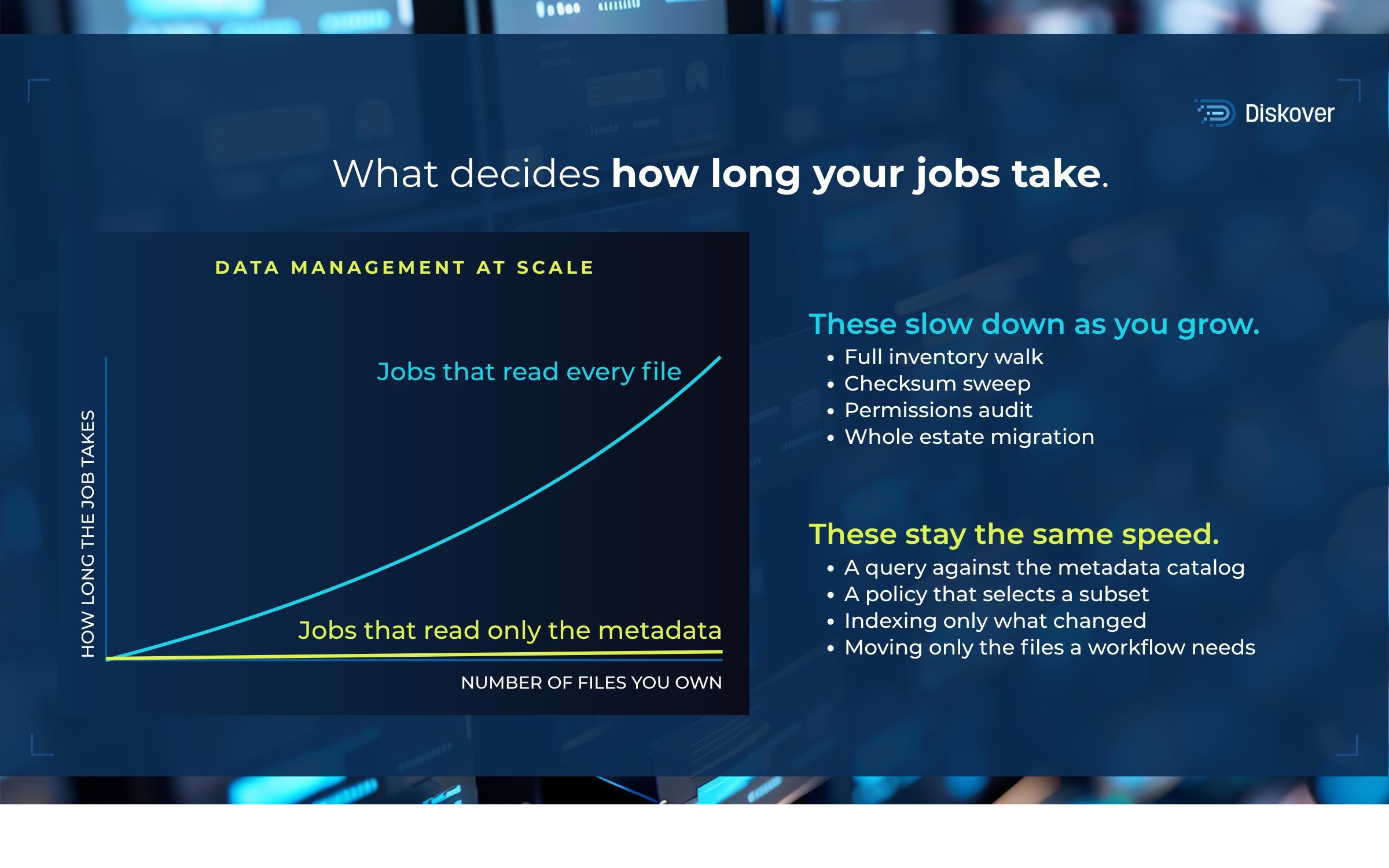
Here is the test that predicts all of it. Every operation in your estate scales with one of two numbers: the count of files you own, or the count of answers you asked for.
Operations that scale with the file count run into a wall you can calculate in advance. Operations that scale with the answer count keep working at any size. A full inventory walk, a checksum sweep, a migration, a permissions audit: all of these read every entry, so all of them are on the clock. The inventory they produce is a static picture, and it starts aging the moment the read begins. A query that returns the 3,000 statements a regulator asked for costs the same whether the estate holds 10 million objects or 10 billion.
Counting stops having an answer.
WHERE WE ARE
Day two. Someone asks how many files the request actually covers.
It sounds like the easy question, and it is the first thing to break. It goes in as a ticket to information technology (IT), becomes a scripted directory walk across four systems, and comes back three days later with a number the team declines to stand behind. Two of the mounts timed out partway through, and the script kept going.
When did your last full inventory finish inside the window you gave it? At a billion objects, a walk that reads every entry is not a report. It is a batch job that takes days, and it competes with production traffic the whole time it runs. Whatever number it returns describes the estate as it was on Monday, when the walk started.
That is why 76% of enterprises make business decisions without consulting available data, because access proves too difficult. The count IT returned was never wrong. It was outdated before it arrived.
Arithmetic breaks before search does, which is the part that surprises people, and it is where the first week goes.
The scan window closes.
WHERE WE ARE
Tuesday of week two. The nightly inventory job is still running when the desk opens.
Everything ran exactly as configured. The job that used to finish at 4am completed at 6am last spring, then 7am by fall, and this week it was still going at market open. Each night the job starts from scratch and reads the whole estate, so its runtime is set by the size of the estate rather than by what changed in it. Meanwhile, the estate grew by a few million records a month while everyone was focused on other priorities.
This is the moment the regime changed, and it passed silently. From the night that job stopped finishing, the inventory describes the past rather than the present, and every policy built on it acts on a static list that is already wrong.
The mechanism that survives this is a change-based index. Rather than re-reading the whole estate on every pass, the system reads what moved since the last pass and updates only those records. The overnight batch that wrote 40 million confirmations shows up on the next pass, rather than waiting for a catalog that started reading yesterday and has reached the letter M.
Diskover uses cached scanning for exactly this reason, so the cost of staying current tracks the rate of change rather than the size of the estate. A quiet 2019 archive stays accurate for a fraction of the work because little of it moved, while the current quarter costs more for exactly that reason.
The bill and the burden separate.
WHERE WE ARE
Still week two. Finance asks why an estate this small is taking three weeks.
A client statement is about 40 kilobytes (KB), and a billion of them is 40 terabytes (TB). That line was approved on sight. Operationally, it is one of the hardest estates to run, because every backup, every replication pass, every restore, and every listing operation is priced per object rather than per terabyte.
The trading desk that generates 3 million confirmations a month adds a few terabytes to the bill. It adds 36 million objects a year to every backup, replication pass and restore, which is why the bill looks calm and the Monday does not.
Which of your storage decisions were made from a capacity report alone? Between the second quarter of 2025 and the first quarter of 2026, VDURA reports that pricing for 30 TB enterprise solid-state drives rose 257%, while hard disk pricing rose 35%, pushing teams toward tiering and archive decisions that depend on per-object economics they have never measured. The estates that cost the most to operate are the ones that looked smallest on the summary page.
Directory structure stops being a schema.
WHERE WE ARE
Day nine. The team has a candidate list, and no way to tell the statements from the drafts of the statements.
The file system records name, size, location, three timestamps, file type, owner, and permissions. That is the vocabulary it gives you by default, and every field in it describes the file rather than what the file means to the business.
Every question this audit asks lives outside that vocabulary. Which of these were issued rather than generated. Which carry a 7-year retention obligation. Which belong to accounts that have since closed. At a million files, folder conventions cover the gap, because a person can read a path and infer meaning from it. /statements/2019/Q3/final/ is a schema that a human being enforces through discipline.
At a billion files, that discipline is already gone. Paths were created by batch jobs, by two platform migrations, by contractors, and by whoever was on call in 2019. The convention lives in a wiki page and in three people’s memory, and two of them have left. The structure they relied on could only be read by a person, and it was asked to answer a question at machine scale.
Global data estate visibility and metadata enrichment are the mechanism that closes this. Tags, checksums, account identifiers, sensitivity classifications, and retention classes attach to the record in the catalog, which turns a folder convention into something a query can reach.
Migration stops being an event.
WHERE WE ARE
Day 12. Half of 2019 sits on an archive that was scheduled for decommissioning last year, and is still running because the move never finished.
Decommissioning that archive at a million files is a scheduled outage. At a billion, it is a staffed project measured in quarters, competing for the same people the audit needs. Any operation that must touch every file becomes a program rather than a weekend. So placement becomes permanent by default. Whatever tier the data landed on in 2021 is where it still lives, because reconsidering costs more than paying for it.
The catalog turns migration back into a selection problem. Rather than moving an estate, you move the subset a policy identifies, with context and control, while the rest stays exactly where it is. The data stays in place while the catalog is built, and it moves only when a workflow calls for it. That is the difference between an operation priced by file count and one priced by answer count.
Deletion becomes the hardest operation.
WHERE WE ARE
Day 15. A client invokes their deletion rights, and the audit is still open.
Removing data sounds like the easy half of lifecycle management. At scale, it is the part that stalls, and here it arrives at the worst possible moment. You can only delete what you can attribute, and attribution requires the catalog the firm postponed building. Somebody now has to certify which files belong to that client, which of those a retention obligation requires the firm to keep, and which can go. Under the California Consumer Privacy Act (CCPA), the clock on that answer runs in days.
The same gap explains a standing cost. An average of 30 to 50% of stored data is redundant, obsolete, or trivial (ROT), and most teams know it, which is why the reclamation project appears on the roadmap every year and stalls in the same place. Somebody has to certify that 300 million specific files are safe to remove, and the evidence for that lives in a system still waiting to be built.
What makes it tractable is asking in plain language and getting a defensible answer back. You describe the files you are looking for, the AI connector returns the matching set with a recommended action attached, and you approve it before anything happens. AI-assisted, human-approved is the operating principle. The certification stops being an archaeology project and becomes a review of a list.
Managing billions of files comes down to one number.
WHERE WE ARE
The audit completed four days late. The same jobs will run against the next request, and the estate is larger than it was in April.
Run that same request against an estate with a current catalog, and it is a different afternoon. You ask for every client statement issued in 2019, you get the matching set with a recommended action attached, and the 20 days go back to the people who were about to spend them.
So go back to the test. For each recurring job in your estate, ask which number sets its runtime: the files you own, or the answers you asked for.
The jobs in the first bucket have an expiry date, and they reach it on a schedule you can calculate from your own growth rate. The firm in this story reached it at a few million records a month, without anyone noticing.
Moving work into the second bucket is what global visibility is for, and it is also why 80% of enterprises report that limited data access is constraining their artificial intelligence (AI) initiatives. The models are ready. The inventory is the part that has yet to finish scanning.
KEY TAKEAWAY
Scale changes which jobs finish.
- A billion files is a different operating regime, rather than a larger version of the one you run today.
- Every job scales with either the count of files you own or the count of answers you requested. The first group has an expiry date.
- The scan window closing is the moment the regime changes, and it passes silently. The first sign is a policy acting on stale records.
- Capacity reports measure bytes while operational cost is charged per object, so small-file estates look calm and run hard.
- Attribution is what makes deletion, migration, and audit possible, and it is built once rather than repeated per request.
Your estate already holds the answer. Ask for it.
Index every file across every vendor, tier, and location. Get deep insights, then act on what you find, with your approval at every step.