

BLOG
Dark data is a compliance problem waiting to happen.
August 10, 2026 · 5 min read
You open the oldest shared drive in your company and start reading file names.
Somewhere in there is a spreadsheet called passwords_final.xlsx. A folder of signed contracts from a deal that closed in 2018. An export from a system you retired years ago, still holding the names, addresses, and card numbers of forty thousand customers.
No one remembers these files. No one is watching them. And every one of them is a liability bearing your company’s name.
This is dark data, the files you store but can no longer see into. Most conversations about it open with wasted spend, and fair enough: it is expensive to keep. But the storage bill is the least of it.
What’s hiding in the dark.
Sensitive data does not sit in a labeled vault. It scatters, in the ordinary course of work, into the same forgotten corners as everything else — and nothing marks it as sensitive when it lands there.
In the dark of an average enterprise, you will find credentials and passwords saved in plain text because it was convenient at the time, payment-card and financial data in old exports and email attachments, and personally identifiable information (PII) names, Social Security numbers, health records — copied out of governed systems into ungoverned spreadsheets. Alongside it sits a decade of contracts and regulated records kept years past the date you were required, or even allowed, to hold them.
None of it was created to be a risk. It became one the moment it left the system that was watching it, and no one wrote down where it went.
Every forgotten copy is exposure.
Every file in your estate multiplies — that is what unmanaged sprawl does. What changes with sensitive data is the price of each copy. One customer record gets pulled into a report, the report gets emailed, the attachment gets saved to three drives, and a single governed database quietly becomes a dozen ungoverned copies. Each copy is two problems at once: a new door into your most sensitive information, and a new place a regulator can hold you accountable for it.
That is the quiet math of dark data. Your true exposure is not the data you are managing. It is the data you are managing plus every copy you have lost track of and for most organizations, the second number overshadows the first.
When it leaks, the dark data is the wound.
Attackers are not only after your production systems. They are after the soft, forgotten stores no one is monitoring. The old shares and stale buckets where sensitive data sits unencrypted and unwatched. When a breach lands, it does not stop at the data you were guarding. The intrusion reaches everything, and the forgotten files are where it does the most damage.
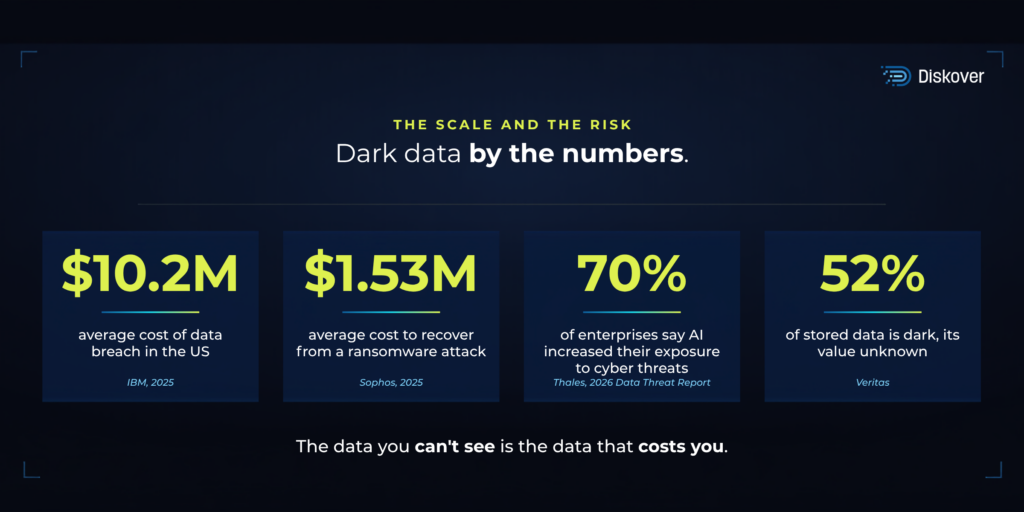
The stakes are not abstract. In the United States, the average data breach now costs $10.22 million, the highest of any country, and a record high, according to IBM’s 2025 Cost of a Data Breach report. And the pressure is climbing: 70% of enterprises say artificial intelligence (AI) has increased their exposure to cyber threats, as more sensitive data is pulled into more systems. IBM’s own researchers arrive at the same point from the other side. The data your security team cannot see is the data that drives up the cost of a breach.
The auditor’s question you can’t answer.
Regulators do not grade you on the data you remember. They grade you on all of it. The California Consumer Privacy Act (CCPA), and its counterparts worldwide, assume you can answer three questions on demand: what personal data do you hold, where does it live, and can you delete it when someone asks? For data you cannot see, the honest answer to all three is no.
So ask yourself the question before an auditor does: if a regulator wanted a complete inventory of the personal data in your estate today, how long would it take — and how sure are you it would be complete? For most teams, the true answer is weeks, and not very. That gap is the difference between a clean audit and a finding, and it is the norm, because 67% of enterprises lack a unified catalog of what they store, meaning most cannot produce that inventory at all.
Retention carries the same blind spot. A record you were required to delete two years ago, still sitting in a forgotten archive, is not a harmless leftover. It is a violation you are holding on to without realizing it.
You can’t protect or prove what you can’t see.
Here is why dark data survives even in security-conscious, well-audited companies: you cannot classify, protect, or defensibly delete what you cannot identify. Delete the wrong file, one under legal hold and you have destroyed records you were required to keep; keep everything, and you keep every liability with it. So the safe-looking choice is to leave it all in the dark, and the exposure compounds.
The problem was never a lack of will. Every security and compliance team wants the sensitive data found, classified, and controlled. What they lack is a way to see it across the whole estate at once. Close that gap, and dark data stops being a threat you cannot measure and becomes a list you can act on.
Bring it into the light.
Because you cannot govern sensitive data you cannot locate, the work starts with visibility. Index the metadata across every system into one searchable catalog, and the estate you could not account for becomes something you can interrogate. Diskover sits above your entire data estate and indexes every file across all storage vendors, tiers, and locations, without moving or copying any files.
From there, finding the sensitive data becomes a question instead of a project. Diskover works from metadata, not the contents of your files; the name, type, location, age, owner, and any enriched attributes you have indexed. That is enough to surface the files that matter most: a spreadsheet named passwords_final.xlsx, the .pst archives and financial exports scattered across your shares, the folder you were required to purge two years ago and never did. With the AI connector, you ask for them in plain language and get the matching files back in seconds, with a recommended action attached. It surfaces and recommends; you approve what happens next. AI-assisted, human-approved.
Then policy does the standing work, automatically. Define a rule once, quarantine anything that looks sensitive, archive what a share should no longer hold, tier cold data down, or delete what is past its retention date, and Diskover carries it out across every tier, with an audit trail behind every action and your sign-off before anything moves. So when the regulator or the auditor asks, the answer is a report, not a scramble and the data you could not see becomes data you can find, account for, and defend.
KEY TAKEAWAY
Visibility comes before control.
Dark data is not a storage problem you can put off until budget season. It is a compliance and security liability compounding in the background — the passwords, card numbers, and personal records you are still accountable for but can no longer see. Policies alone will not fix it, and you cannot delete what you cannot find.
Diskover provides you with visibility and control over your files, helping you find sensitive data across every tier, locating where it lives, flags it, and enforces retention with an audit trail behind every action. It is the foundation the rest of your compliance work stands on, because no policy, audit, or GRC program can govern what it cannot find. Diskover is what puts you in control.
The way out is light: the moment your sensitive data becomes searchable, the breach you were exposed to and the audit you were dreading turn into a list you can work down.
Find your sensitive data hiding in the dark.
Surface the files most likely to hold sensitive and regulated data and see exactly where they live.