

DISKOVER BLOG
Metadata, your most underused asset.
Jul 29, 2026 · 4.1 min read
Most enterprises fund three things without hesitation: storage capacity, compute, and the data itself. The asset that makes all three legible attracts almost no investment.
That asset is metadata.
Metadata is the information your systems already record about every file. Who owns it, when it was last touched, how large it is, where it lives, and what it contains. One file’s metadata looks trivial. Across billions of files, it becomes a map of your entire data estate. Most organizations never access that map, leaving behind valuable business insights.
Your most overlooked asset, hiding in plain sight.
Every file your organization produces generates metadata. The limitation is not creation. It is that the record stays resident inside the system that produced it, in a format built for that system, at a volume no person can read.
Raw metadata also stops short of the answer. A size and timestamp tell you nothing about the project a file belongs to, the client it serves, the regulation that governs it, or the revenue it supports. Enrichment closes the distance. Diskover extracts technical detail from inside the file and joins it to the business systems around it, so an object stops being a path and a byte count and becomes a piece of work with an owner, a purpose, and a cost.
Why does it stay unused?
Metadata goes unused because at enterprise scale it is invisible. A single network-attached storage (NAS) array can hold hundreds of millions of files. No manual process can scale to that volume. No single system was designed to seek outside itself.
The question is scope, not capability. Storage platforms are engineered to hold, protect, and serve data at scale, and the leading ones do that exceptionally well. Each of them records detailed metadata about what it holds, in a format built for that system. A metadata control plane sits above the storage layer and reads across all of them, turning what every platform knows about its own contents into one catalog the enterprise can query. Your storage keeps doing what it does best. The intelligence it already produces becomes usable everywhere.
The visibility gap carries a number. Enterprises spend six and seven figures a year holding files no one in the organization can describe, while the intelligence required to describe them sits unread inside those same systems.
The most valuable insight into your data is the insight you already own.
What changes when metadata becomes the control plane.
Treat metadata as a competitive advantage rather than a byproduct, and the operating picture changes. Index it across every environment into one enriched, searchable catalog, and what you gain is business context, not a list of files. Which data is active. Which projects are dormant. What each dataset costs to hold. Which teams depend on it.
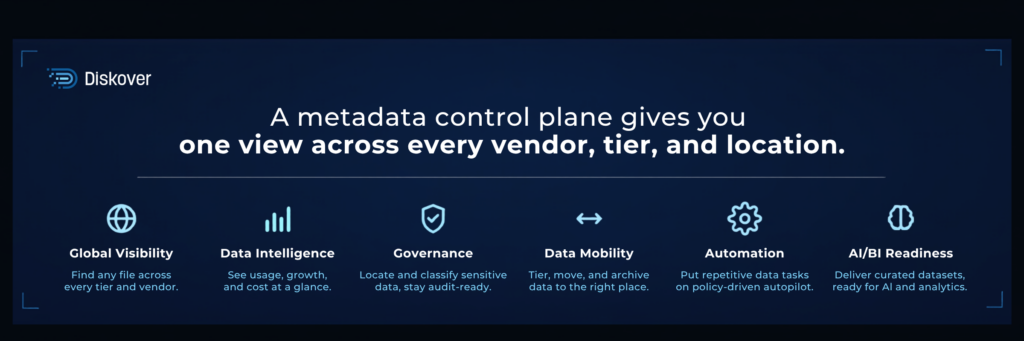
Ask in natural language and receive an answer in minutes, across your entire data estate. Which datasets have gone untouched for years, and what would tiering them return? Where does regulated personal data live, and under which governance rules? What datasets are complete, current and ready for an artificial intelligence (AI) pipeline?
That third question has a legal edge most enterprises still handle manually. Data residency requirements differ by country, and several demand that personal data stay where it was collected, which prevents pulling everything into one system to examine it. The General Data Protection Regulation (GDPR) reaches furthest, extending to European Union residents’ information regardless of where your systems sit. Diskover indexes and queries in place, without moving or copying a file. When a regulator asks what you hold and where it lives, the answer is a query, not a project.
Enterprises trust Diskover with their most valuable holdings, at scale and under time pressure. The platform indexes 1.4 billion files in 18 hours on a single node against an enterprise NAS. That puts the answer inside the window the business is working in rather than a quarter behind it. Your entire data estate, enriched, indexed, and ready to deliver insight to your team. The business context and competitive advantage previously hidden in siloed unstructured data, now searchable in natural language and ready for AI consumption.
KEY TAKEAWAY
What ignoring it actually costs you.
Unused metadata rarely shows up as one dramatic number. It shows up as drift. Capacity purchased because no one could see what was already there. Cold data billed at premium rates. Egress charges on transfers that duplicated work already in place. AI projects stalled while teams hunt for the right files.
Metadata visibility does not land on one team. It changes the quality of the decisions every function is already making. Infrastructure retires what no one has opened in years. Finance charges cost back to the business unit that generated it. Legal defends retention with a record instead of a policy. Data teams find datasets that qualify in days rather than quarters.
More infrastructure is not the answer. Your enterprise already generates valuable metadata. The question is how you gain visibility and business context across every tier and every environment. Start with one question your team cannot answer today, such as how much of your data has gone cold, and the exercise will reveal just how much intelligence has been sitting unused.
Metadata is the advantage you already own.
Get one view of your estate and the answers your current tools cannot return. See what you hold, what it costs you, and what to do about it.